

How to Choose an Amazon Product Photography Service: A 12-Point Checklist for Sellers, Brand Owners, and Ecommerce Teams
- Published:
- 2026-07-03 10:00:00
- Source:
- AIMI Visual Media
- Reading Time:
- 14 min read
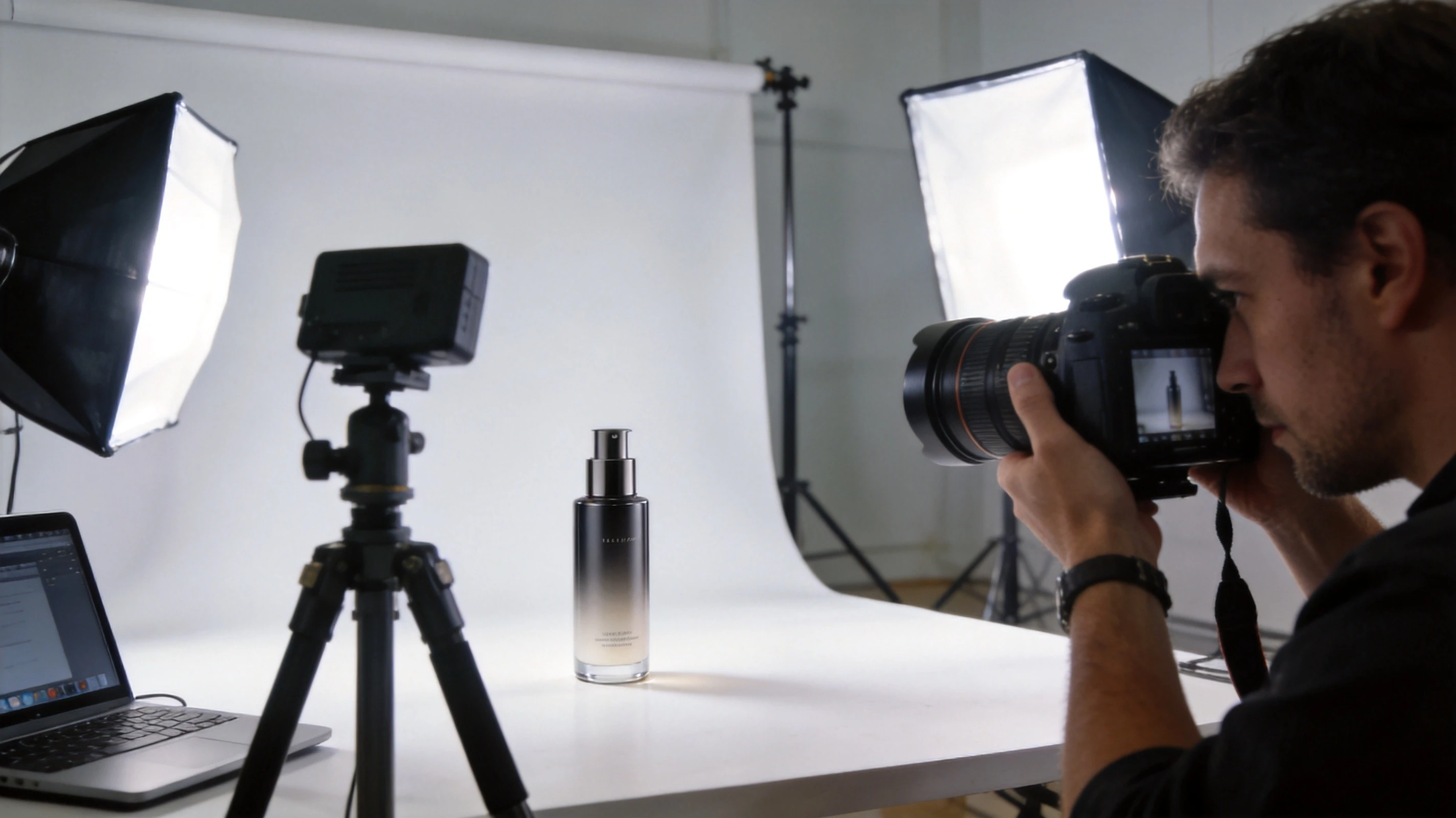
A professional commercial product photography studio set up for Amazon-compliant white-background hero shots.
Introduction: Your Images Are Your Sales Floor
On Amazon, the customer never walks into a store, never touches the product, and never speaks to a salesperson. Your product images are the entire sales floor. According to Amazon's own seller guidance and independent conversion studies, product imagery is the single highest-leverage asset on a listing — responsible for roughly 75% of a shopper's purchasing decision before they read a single bullet point. Industry research cited by SupplyKick's 2026 agency buyer's guide and PixelPanda's 2026 compliance report confirms that listings with zoom-enabled, professionally shot images convert up to 30% better than listings without, and that non-compliant main images are rejected by Amazon's automated AI checks within minutes of upload, often resulting in suppressed search visibility until the issue is fixed.
Yet most sellers still choose a product photography service the wrong way: they sort Fiverr by price, hire a local wedding photographer, or accept the cheapest quote from a factory in China — and then wonder why their conversion rate stalls. Choosing the right Amazon product photography service is not a creative preference; it is a high-stakes operational decision that directly affects your click-through rate, conversion rate, return rate, advertising cost of sale (ACoS), and brand perception.
This article gives you a battle-tested 12-point checklist you can use to evaluate any Amazon product photography service — whether you are comparing freelancers, dedicated Amazon studios, full-service agencies, or in-house-capable production houses. Each point includes concrete evaluation criteria, specific questions to ask during discovery, and the red flags that should disqualify a vendor immediately. We draw on Amazon's official 2026 image requirements (Seller Central, Product Image Requirements Guide), industry pricing benchmarks from 2026, and hands-on experience producing imagery for over 6,000 brands across Amazon, Shopify, and direct-to-consumer (DTC) channels.
Use a structured checklist to evaluate photography vendors — avoid deciding on price alone.
The 12-Point Checklist at a Glance
| # | Evaluation Criterion | What It Protects You From |
|---|---|---|
| 1 | Amazon Image Compliance Expertise | Suppressed listings, AI-driven rejections |
| 2 | Portfolio Quality & Niche Experience | Off-brand visuals, failed category tests |
| 3 | Studio Equipment & Facilities | Inconsistent quality, limited scalability |
| 4 | Image Resolution & Technical Specs | Broken zoom, pixelated mobile experience |
| 5 | White-Background & Lifestyle Capability | Incomplete creative, multiple-vendor friction |
| 6 | Retouching & Post-Production Quality | Cheap composites, color drift, returns |
| 7 | Turnaround Time & Scalability | Missed launches, catalog-wide bottlenecks |
| 8 | Pricing Transparency | Hidden fees, bloated invoices |
| 9 | Revision Policy & Communication | Endless back-and-forth, missed brand cues |
| 10 | Client Reviews & Social Proof | Vanishing freelancers, unknown reliability |
| 11 | Additional Services (A+, Video, 360°) | Fragmented vendor stack, inconsistent brand |
| 12 | Geographic Proximity & Shipping Logistics | Damaged samples, slow iteration, customs delays |
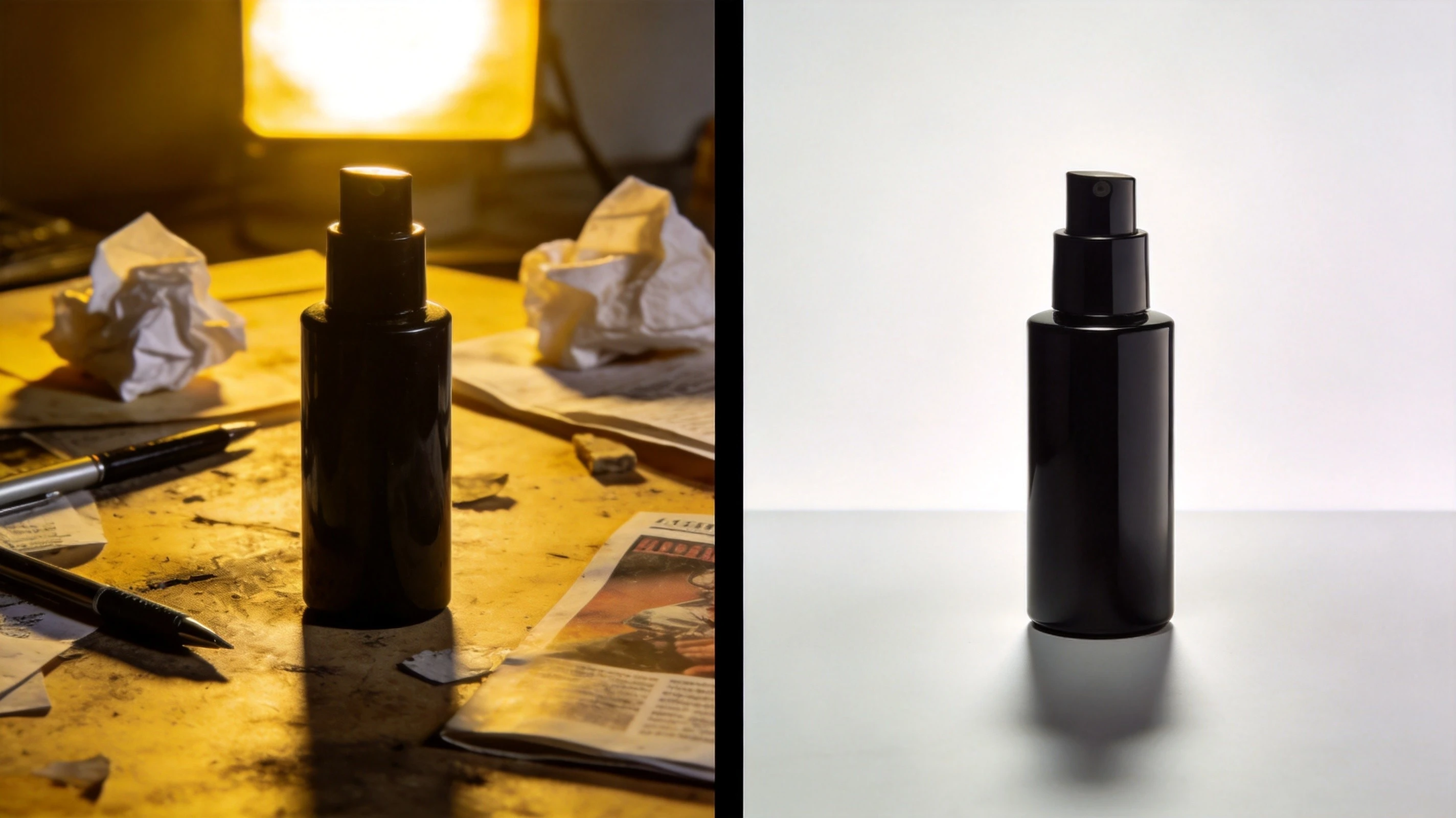
Left: a non-compliant, poorly lit amateur product photo. Right: an Amazon-compliant professional image — pure white background, even studio lighting, accurate color, and proper 85% frame fill.
1. Amazon Image Compliance Expertise
Compliance is table stakes — not a differentiator. Amazon's automated image-review system, enhanced in 2026 with AI compliance checks, flags violations within minutes of upload and can suppress your listing before a human ever sees it. Per Amazon's official Seller Central Product Image Requirements and the 2026 PixelPanda compliance guide, main images must meet precise rules: pure white background (RGB 255, 255, 255), product filling at least 85% of the frame, no text or logos or watermarks, no props or models (except in permitted categories), no packaging unless it is the product itself, and a minimum of 1000 pixels on the longest side to enable zoom.
What to Evaluate
- The studio can recite Amazon's main-image rules from memory — white background (RGB 255,255,255), 85% frame fill, zero text/logos/watermarks, no props in the hero shot.
- They understand category-specific carve-outs (apparel on model, shoes at a 45-degree left-facing angle, adult vs. children's apparel rules, consumable packaging rules).
- They deliver files already named to Amazon conventions (ASIN.MAIN.jpg, ASIN.PT01.jpg, etc.) so you do not have to rename dozens of files.
- They stay current with rule changes — Amazon updates image policy multiple times per year (the 2025 lifestyle-main-image restriction and 2026 automated AI enforcement are two recent examples).
- They have a pre-upload QA process that screens for RGB values, frame fill %, text detection, and resolution before delivery.
Questions to Ask Your Photographer
- Can you show me three main images you shot in our category in the last 90 days that passed Amazon upload on the first try?
- How do you verify that the delivered background is exactly RGB 255,255,255 — not 252,252,252?
- What happens if Amazon rejects an image you delivered — do you correct it for free?
- How do you stay current when Amazon updates its image policy mid-campaign?
2. Portfolio Quality & Niche Experience
General commercial photography and Amazon product photography are different crafts. A fashion editorial photographer or a food photographer may produce stunning work but fail at the disciplined, conversion-optimized aesthetic Amazon rewards. The right vendor for you should have deep, demonstrable experience in your exact product category — supplements, electronics, apparel, home goods, beauty, jewelry, or toys each have their own lighting, staging, and customer-expectation conventions.
What to Evaluate
- They can show you at least 5-10 live Amazon listings in your category that they shot, not just curated portfolio images.
- Their work demonstrates category-appropriate lighting: hard-edge specular control for shiny electronics, soft wrapping light for cosmetics, texture-revealing light for apparel fabric, sterile clinical light for medical/supplement products.
- Consistency across the gallery — same color temperature, same shadow direction, same framing logic — signals a repeatable process, not lucky one-off shots.
- They can articulate why they shot a product a certain way (angle, light, fill ratio) in relation to conversion, not just aesthetics.
- They can provide creative direction if you do not have an in-house art director — i.e., they propose angles, propping logic, and hero-shot strategies.
Questions to Ask Your Photographer
- Can you share live ASINs in our exact category that you have shot in the last 6 months?
- What is your approach to lighting reflective/high-gloss/transparent products like ours?
- Who owns creative direction — do you propose shots, or do we send a shot list for you to execute?
- Can you show a split test or case study where your images improved a client's conversion rate?
3. Studio Equipment & Facilities
The caliber of a photography studio's facility directly predicts its consistency and scalability. A one-person freelancer with a single speedlight and a folding table can produce a usable image of a mug; they cannot produce 500 SKUs of reflective chrome kitchenware to identical color and shadow specifications across a three-month launch window. As a benchmark, professional product photography studios operate full-frame camera bodies (Sony a7 IV / Canon R-series / Nikon Z-series equivalent), strobe or high-CRI continuous lighting, calibrated monitors, color management (X-Rite ColorChecker), tethered capture, and dedicated sets for white-background, lifestyle, and macro work.
What to Evaluate
- Purpose-built studio space (not a converted apartment) with ceiling height sufficient for overhead and sweep setups.
- Full-frame camera bodies (24MP+), prime or macro lenses appropriate to your product size, and tethered shooting to Capture One or Lightroom so clients can review shots live.
- Studio strobes (Broncolor, Profoto, Godox AD-series class) — not speedlights — for consistent flash duration and color temperature.
- A complement of light modifiers: softboxes in multiple sizes, strip boxes, octaboxes, scrims, reflectors, v-flats, and dedicated product shooting tables or infinity coves.
- Color-calibrated workflow: calibrated monitors (BenQ SW / Eizo class), X-Rite or Datacolor color targets, custom camera profiles, and sRGB delivery to Amazon's spec.
- Dedicated sets running in parallel (multiple studios / bays) — this is what enables scale and fast turnaround.
Questions to Ask Your Photographer
- What camera bodies, lenses, and lighting do you use for product work?
- Do you shoot tethered, and can we attend the shoot remotely (live stream or real-time gallery)?
- How do you manage color accuracy — do you use a ColorChecker and calibrated displays?
- How many dedicated photo studios/bays do you operate, and how many can run in parallel for a large catalog?
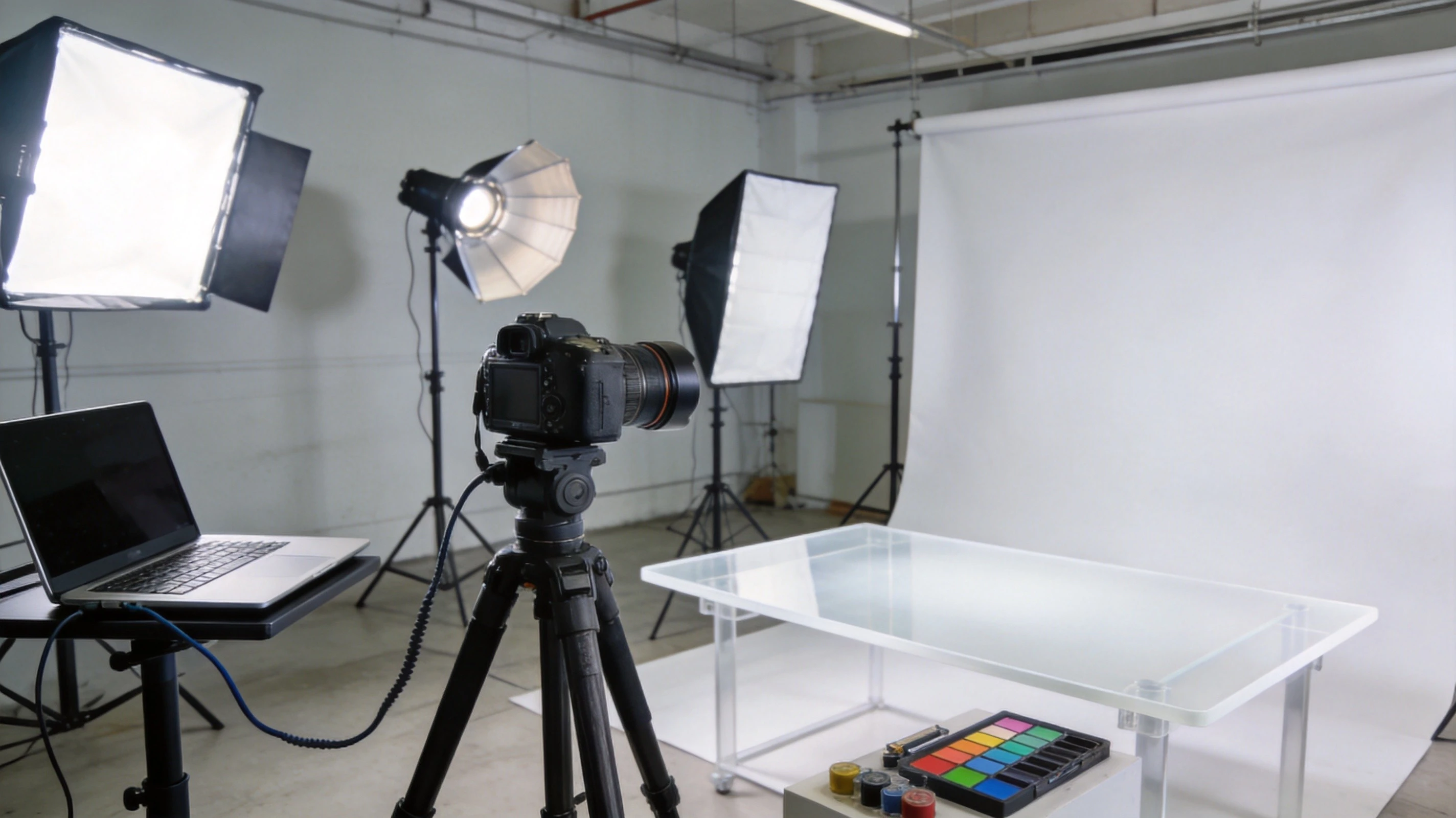
A well-equipped professional product studio: strobes, softboxes on C-stands, a white seamless sweep, tethered capture, and color-managed workflow.
4. Image Resolution & Technical Specifications
Amazon's published technical requirements are the floor, not the ceiling. The marketplace accepts JPEG, PNG, TIFF, and non-animated GIF (JPEG preferred), with the longest side between 500 and 10,000 pixels, at least 72 DPI, and sRGB or CMYK color mode. But the zoom function — which Amazon's own data shows lifts conversions by roughly 30% — requires at least 1000 pixels on the longest side, and the engagement sweet spot for both zoom clarity and page-load speed is 2000-2500 pixels square. (See PixelPanda's 2026 guide and Amazon Seller Central.)
What to Evaluate
- They deliver at 2000×2000 pixels or larger (2500×2500 is best practice), JPEG, sRGB, at a quality level that balances file size and clarity.
- Files are sharp edge-to-edge, with no motion blur, no focus breathing, no over-sharpening halos.
- They understand Amazon's 10 MB per-file ceiling and optimize without introducing compression artifacts.
- They can deliver source RAW files on request (or, more commonly, high-bit-depth TIFF/PSD masters) if you want to repurpose imagery for A+ Content or ads later.
- Mobile performance: files are compressed so the listing loads fast on cellular connections (page speed affects conversion and ad quality score).
Questions to Ask Your Photographer
- What resolution and file format do you deliver as standard?
- Can you provide 2500×2500 pixel JPEGs in sRGB for the hero shots?
- Do you include the source RAW files or high-resolution masters in your package, or is that an extra charge?
- How do you balance image quality with file size for mobile load performance?
5. White-Background & Lifestyle Capability
A strong Amazon listing uses multiple image types, not just a single hero. Per Amazon's guidance, sellers should provide at least 6 images and 1 video per listing, and most top-performing listings use all 9 image slots. The high-conversion image mix typically includes: (1) a pure white-background hero, (2) a lifestyle or in-use shot, (3) a feature close-up, (4) a scale/dimension shot, (5) an unboxing or in-box contents shot, (6) a benefit infographic, (7-9) additional angles, use cases, or category-specific detail. This means your photography service must be competent at two very different disciplines — clinical white-background studio work and richly styled lifestyle imagery — ideally under one roof.
What to Evaluate
- White-background mastery: perfectly clean RGB 255,255,255 backdrops, natural contact shadows (not floating objects), consistent fill ratios across SKUs.
- Lifestyle capability: access to sets, props, surfaces (marble, wood, linen, concrete), and optionally models through trusted partner agencies.
- Infographic design: ability to overlay clean, legible callouts, dimension lines, and feature badges (without using Amazon-prohibited claims like "Best Seller").
- Scale/dimension shots: an in-house prop library or stylist who can communicate size intuitively (hand for scale, common household objects, dimension lines).
- Category-specific imagery: flat-lays for accessories, on-model shots for apparel, ingredient callouts for supplements, installation sequences for home goods.
Questions to Ask Your Photographer
- Do you shoot both white-background heroes and lifestyle images in-house, or is lifestyle subcontracted?
- Can you handle infographic overlays and dimension graphics as part of the package?
- Do you have access to models, location sets, or stylists if we need lifestyle with people?
- How do you handle reflective, transparent, or matte-black products that are notoriously hard to light on white?
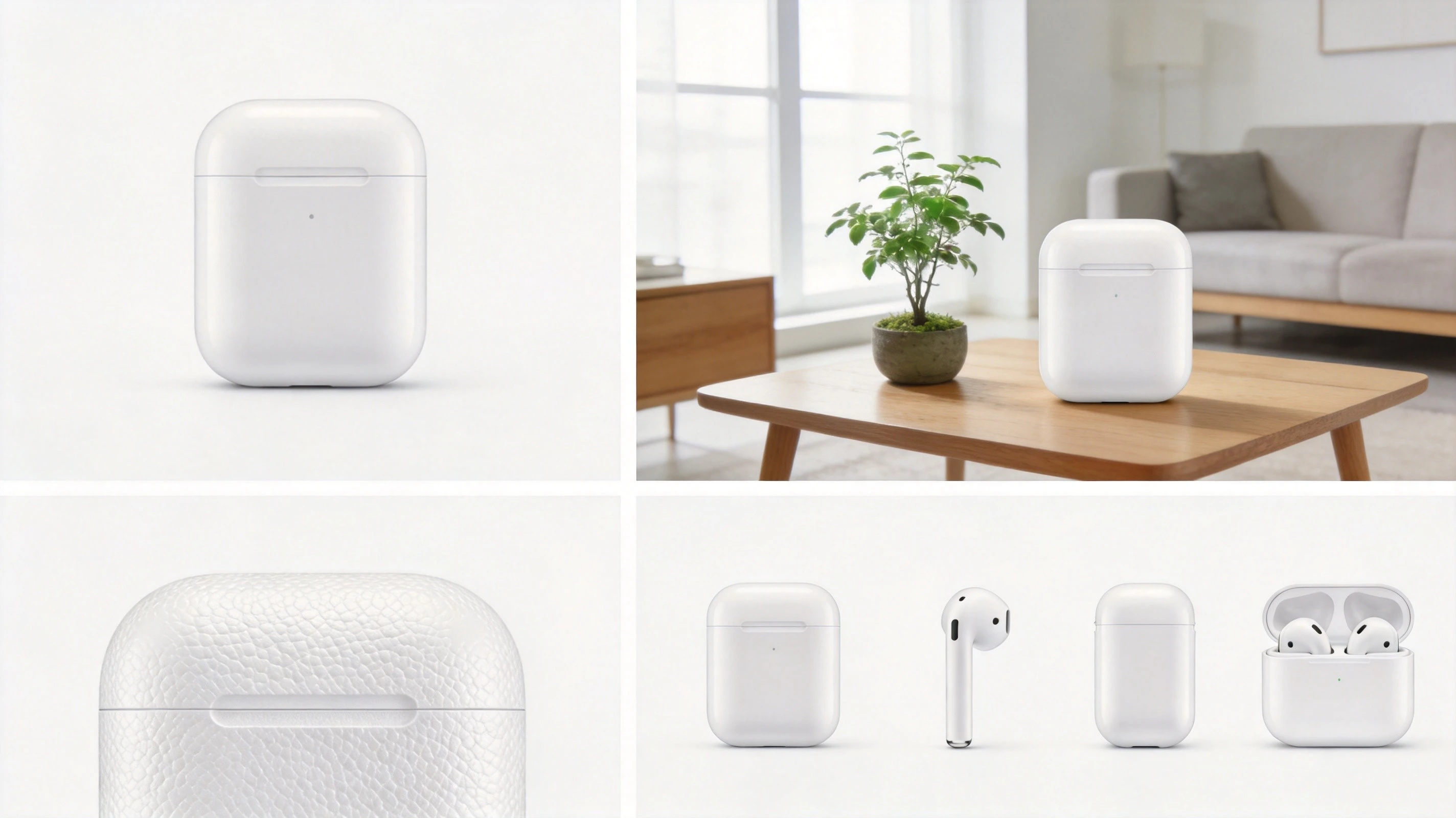
A complete Amazon image set combines white-background hero shots, lifestyle context, macro close-ups, and (optionally) 360-degree spin views.
6. Retouching & Post-Production Quality
A mediocre photograph beautifully retouched will outperform a great photograph badly retouched every time on Amazon. Post-production is where 90% of the "premium look" is made — but it is also where over-processing destroys trust. High-end Amazon retouching is not about making products look fake; it is about removing distractions (dust, fingerprints, minor molding flaws, loose threads) while preserving texture, accurate color, and honest material representation so the customer receives what they expect. Over-retouching is a leading cause of product returns, because the item received does not match the image.
What to Evaluate
- Non-destructive workflow: they keep layered PSD/TIFF masters so future edits (new packaging, updated labels, color variants) are fast.
- Discipline in retouching: dust and spec cleanup, color correction, background cleanup, natural shadow rebuilding — but no plastic-skin over-smoothing, no fake reflections, no removal of legitimate product texture.
- Color accuracy: they match PMS / brand colors or supplied reference swatches, and they do so on a calibrated monitor in a color-controlled viewing environment.
- Consistency across the catalog: every SKU in a line has the same shadow direction, same highlight intensity, same white balance — so the product page and brand store feel unified.
- Dedicated in-house retouching team (not outsourced to an unknown overseas retouch farm) so quality stays consistent and revisions turn around quickly.
Questions to Ask Your Photographer
- What does your standard retouching include — and what costs extra?
- Do you retouch in-house or outsource post-production?
- How do you ensure color consistency across a 50-SKU product line?
- Can you deliver layered PSD masters for future brand updates?
- How do you handle products that arrive with minor factory defects — do you clean them up, flag them, or reshoot?
7. Turnaround Time & Scalability
Amazon selling is calendar-driven: Prime Day, Black Friday / Cyber Monday, Q4 holiday, back-to-school, and category-specific seasonal windows. A photography vendor who can deliver 20 great images in 5 days but cannot handle 300 SKUs in 6 weeks is not a scalable partner. Industry benchmarks from SupplyKick's 2026 pricing guide and the EvolveAMZ 2026 studio comparison place typical specialized-Amazon-studio turnaround at 5-10 business days per batch for small orders, with premium studios offering 3-5 day rush service at a 20-50% premium. Large catalog shoots (100+ SKUs) should run on a defined weekly cadence with parallel setups.
What to Evaluate
- Clear, written turnaround commitments per project scope (first proof, revision cycle, final delivery).
- Capacity to scale: they operate multiple studios/bays and can add photographers and retouchers to your project when needed.
- A dedicated producer or account manager who owns your timeline — not a generic inbox.
- Realistic rush pricing (20-50% premium for expedited) rather than absurd "fast lane" surcharges.
- A defined process for new-product launches where samples arrive, are logged, prepped, shot, retouched, QA'd, and delivered on a predictable schedule.
Questions to Ask Your Photographer
- What is your standard turnaround for a 10-SKU shoot vs. a 100-SKU launch?
- How do you handle rush requests — what is the premium and the fastest you can deliver?
- Who is my single point of contact responsible for hitting the deadline?
- What happens if you miss the agreed delivery date — is there any remedy in the contract?
- How do you handle mid-shoot scope changes (adding SKUs after the shoot is booked)?
8. Pricing Transparency
Product photography pricing in 2026 spans a wide range depending on deliverable type. Per-image pricing for white-background hero shots generally runs $20-$75 per image. Per-ASIN / per-listing packages (typically 5-8 images including hero, angles, infographic, lifestyle) range from $400-$700 at the budget tier, $700-$1,500 in the mid-range, and $1,500-$3,500 for premium packages with real models, location shoots, full A+ content, and video. Add-ons include models ($300-$800), location shoots ($500+), 360 spin ($200-$500), and video ($500-$2,000). Full-service agency retainers start at $3,000-$5,000/month for small catalogs and scale up from there (sources: SupplyKick 2026, DesignKit 2026 Pricing Guide, ProductPhotographyForAmazon.com published rates).
What to Evaluate
- They give you a written, itemized quote that lists every included deliverable and every possible add-on price.
- They define what "one image" means (hero white-bg? lifestyle with propping? retouched and Amazon-ready?) rather than using vague counts.
- Revision rounds are explicit (e.g., "two rounds of minor revisions included; major reshoots billed at X").
- Rush fees, model fees, location fees, prop costs, and shipping are disclosed up front.
- Their pricing makes sense for your stage — a $500/ASIN package with unlimited revisions and creative direction is a better deal than a $300 package that charges $50 per revision.
Questions to Ask Your Photographer
- Can you share a sample invoice for a project similar to ours so I can see how pricing is broken down?
- What is included vs. what is extra (retouching rounds, infographics, lifestyle, models, props, shipping)?
- Do you offer bulk pricing for 50+ or 100+ SKU launches?
- What happens if I am not satisfied — how many revision rounds are included, and what triggers a reshoot charge?
9. Revision Policy & Communication
Even the best photographer will miss on the first proof — that is normal. What separates a professional Amazon photography service from an amateur is how they handle revisions. Strong vendors treat revision rounds as part of the creative process, not as a favor. They deliver proofs in an organized gallery (not a WeTransfer dump of 500 RAWs), they ask structured feedback questions, and they respond quickly. Poor vendors treat feedback as an annoyance, disappear after deposit, or reply in 2-word WhatsApp messages.
What to Evaluate
- A defined, reasonable revision policy (e.g., two rounds of minor retouching/composition revisions included; major reshoots caused by vendor error are free; reshoots caused by client scope change are billed transparently).
- A single accountable point of contact — producer, account manager, or dedicated Slack/email thread — not a rotating cast.
- They deliver proofs through a gallery tool (ShotFlow, Frame.io, Pixieset, Ziflow, or a branded portal) where you can annotate specific images rather than typing "the second image on the left is too dark" in an email.
- They ask clarifying questions rather than blindly executing every comment — a sign they care about the outcome, not just checking boxes.
- Time-zone alignment or explicit working-hours agreement, especially when working with overseas studios.
Questions to Ask Your Photographer
- How many revision rounds are included, and what is the turnaround per round?
- How do you prefer to receive feedback — annotated gallery, email, spreadsheet, live call?
- Who is my single point of contact, and what are their working hours and response-time commitment?
- If a revision reveals that a shot needs to be reshot (not just retouched), is there a charge?
10. Client Reviews & Social Proof
Every photography service has a polished portfolio. Portfolio images are cherry-picked. What predicts your experience is what happens after you sign the contract — and that information lives in client reviews, case studies, referrals, and third-party directories. Demand social proof beyond the vendor's own website.
What to Evaluate
- Verified reviews on independent platforms (Google Business Profile, Clutch, Sortlist, Trustpilot), not just testimonials hosted on their site.
- Case studies with measurable outcomes ("our images lifted conversion 28%" vs. "client loved the photos").
- Reference clients in your category or at your scale that you can speak with directly.
- Client retention: long-term client relationships (multi-year, multi-launch) signal repeatable satisfaction.
- Brand-caliber signal: recognizable brands in their portfolio indicates they have been through procurement, legal, and brand-guide compliance processes — a good proxy for operational maturity.
Questions to Ask Your Photographer
- Can you provide two or three reference clients in our category we can contact directly?
- Do you have case studies that quantify the impact of your imagery on CTR, conversion, or sales?
- What is your client-retention rate — what percentage of revenue comes from repeat clients?
- Have you worked with brands of our size and stage (bootstrapped seller, mid-market, enterprise)?
11. Additional Services: A+ Content, Video, 360-Degree Spins
The strongest Amazon listings in 2026 do not stop at still images. Brand-registered sellers use A+ Content (previously Enhanced Brand Content) to add comparison charts, lifestyle modules, and brand story sections — Amazon reports that A+ Content typically lifts conversion 3-10% in competitive categories. Video is now a near-universal expectation on listings, with Amazon recommending at least one product video per ASIN. 360-degree interactive spins are increasingly common in premium categories (electronics, appliances, luxury goods), and some studies show they can reduce returns by 20-40% by giving customers a near-tactile view of the product.
What to Evaluate
- A+ Content design capability in-house — not just photography, but module layout, graphic design, copywriting, and Amazon-approved upload formats.
- Video production: 30-60 second product videos (hero overview, unboxing, installation, lifestyle), shot and edited in-house or through a proven video partner, delivered in Amazon's accepted format.
- 360-degree spin photography: a turntable setup capable of 24-72 frames per rotation, with output compatible with Amazon's 360-viewer where supported.
- Brand Story modules, Amazon Storefront creative, Sponsored Brand video ad creative, and social-cutdowns for TikTok/Instagram — all of which extend the value of a single shoot day.
- Ability to deliver assets formatted for other channels (Shopify, Walmart, Etsy, TikTok Shop) so you are not producing photography twice for the same product.
Questions to Ask Your Photographer
- Do you offer A+ Content design and layout, or just the source photography?
- Can you shoot and edit a 30-60 second product video in the same project, or is that a separate team?
- Do you do 360-degree spins, and can you deliver in a format compatible with Amazon's 360 viewer?
- Can you repurpose the assets for Shopify, Walmart, TikTok Shop, or paid social at the end of the project?
- Do you provide Storefront and Brand Story creative as well?
12. Geographic Proximity & Shipping Logistics
Where your photography studio is located has three concrete consequences: (1) how fast and cheaply you can get physical samples to them; (2) how quickly you can iterate, reshoot, or add last-minute SKUs; and (3) how well they understand the manufacturing, packaging, and quality-control context of your supply chain. For sellers whose factories are in China (which is the majority of Amazon private-label sellers), a photography studio based in a major Chinese manufacturing hub — Guangzhou, Shenzhen, Yiwu, Dongguan — eliminates international shipping, customs delays, and language friction between the factory and the photo team. For US-based brands with US-made inventory, a domestic studio may make more sense.
What to Evaluate
- Proximity to your factory or warehouse for fast, low-cost sample shipping and the option to shoot directly off the production line.
- Clear shipping and sample-handling protocol: are samples insured? Do they return them after the shoot? How are fragile or high-value items handled?
- Language capability: fluent English account management if you are working cross-border (critical for Chinese studios serving Western sellers).
- Time-zone coverage: do they have overlapping working hours for live feedback sessions?
- On-site or remote-shoot attendance option: some larger studios offer live streaming of the shoot so clients can direct remotely in real time.
Questions to Ask Your Photographer
- Where is your studio physically located, and how does that affect shipping time and cost for our samples?
- Will samples be returned after the shoot, and who pays for return shipping?
- How do you handle high-value or fragile products during shipping and handling?
- Can we attend the shoot live (in person or via streamed video) to direct the session?
- What languages does your account management team support?
Quick Decision Framework: Which Tier Is Right for You?
Not every seller needs a premium studio. The right choice depends on your catalog size, stage of business, and the role imagery plays in your strategy. Based on 2026 market pricing and capability benchmarks, here is how the decision typically lands:
| Your Situation | Best Fit | Budget (2026) | Watch Out For |
|---|---|---|---|
| Testing a new product (1-5 SKUs, low budget) | Freelancer marketplace (Fiverr, Upwork) or budget white-bg service | $20-$50/image; $300-$600/ASIN | Inconsistent quality; no A+ or video; no long-term relationship |
| Active catalog, moderate launch cadence (10-50 SKUs) | Specialized Amazon photo studio (domestic or nearshore) | $700-$1,500/ASIN; 5-10 day turnaround | Verify niche experience and revision policy; get references |
| Large catalog launch, brand-building, Prime Day/Q4 push (50+ SKUs) | Dedicated production studio with multi-bay capacity and account management | $1,000-$2,500/ASIN or monthly retainer $5k-$15k+ | Ensure scale capacity, project management, multi-channel deliverables |
| Enterprise / global brand, ongoing catalog management | Full-service creative agency or in-house-partner studio | Retainer $10k-$25k+/month | Look for brand-guide discipline, EDI/procurement readiness, global brand clients |
Choosing an Amazon product photography service is not a one-time transaction — it is a creative partnership that compounds over launches. The right vendor will not only deliver compliant, conversion-ready images; they will also become a strategic partner who understands your brand, anticipates seasonal opportunities, and scales with you as your catalog grows.
If you are launching a new product line, preparing for Prime Day or Q4, or simply tired of working with vendors who do not understand Amazon's rules, it is worth talking to a specialized studio with a proven track record across thousands of brands. AIMI Visual (airmie.com) is one such studio — a Guangzhou-based ecommerce photography production house with dedicated photo studios spanning 3,000 square meters, a 100+ person team, and a client roster that includes global brands such as TCL, YONEX, and NetEase, along with thousands of Amazon sellers and DTC brands. Services include Amazon-compliant white-background hero shots, lifestyle photography, A+ Content design, product video, and 360-degree spins — all produced under one roof with in-house post-production.
You can reach the AIMI team at maggie@airmie.com or by phone at 400-9988-510, or explore case studies and service details at www.airmie.com.
Conclusion
Your Amazon product images are the highest-leverage asset on your listing. They determine whether a shopper clicks, stays, reads, trusts, and buys — and they do all of that in the first two seconds of a search result. Choosing the wrong photography service does not just cost you the studio fee; it costs you months of suppressed conversion, higher ACoS, unnecessary returns, and lost ranking while competitors with better imagery pull ahead.
Use the 12-point checklist in this article as your structured evaluation framework, not as a loose suggestion. Compliance comes first. Then category experience, production capability, technical quality, full image-mix competence, post-production discipline, speed, transparent pricing, communication maturity, social proof, multi-format capability, and logistics — in that order. Score each vendor on every point, compare apples to apples, and hire the partner who scores highest for your stage, not the one with the cheapest quote.
Frequently Asked Questions
How much does professional Amazon product photography cost in 2026?
For 2026, white-background main images typically cost $20-$75 per image. Full per-ASIN packages (5-8 images including hero, angles, and at least one infographic or lifestyle shot) range from $400-$700 for budget providers, $700-$1,500 for mid-range specialized Amazon studios, and $1,500-$3,500 for premium packages with real models, location shoots, full A+ Content, and video. Monthly retainers for ongoing catalog management start at $3,000-$5,000 for small catalogs and scale to $10,000-$25,000+ for enterprise-scale programs. Always confirm what is included versus billed as add-ons (retouching rounds, infographics, models, props, shipping, rush fees).
What are Amazon's official image requirements for 2026?
Per Amazon's Seller Central Product Image Requirements, main images must: use pure white background (RGB 255, 255, 255); show the product filling at least 85% of the frame; contain no text, logos, badges, watermarks, or borders; show the actual product (not a rendering or placeholder) without props, mannequins, or lifestyle context; be in JPEG, PNG, TIFF, or GIF format (JPEG preferred); and measure at least 1000 pixels on the longest side to enable the zoom function (2000-2500 pixels is recommended for best engagement). Amazon's AI-powered compliance system (rolled out broadly in 2025-2026) flags violations within minutes of upload.
How many images should an Amazon listing have?
Amazon requires a minimum of one main image per listing and allows up to 9 images (1 main + 8 additional) plus one video. Amazon recommends at least 6 images and 1 video per product. High-converting listings typically use all 9 slots with a structured mix: white-background hero, lifestyle/in-use shot, feature close-up, scale/dimension shot, contents/unboxing shot, benefit infographic, and 2-3 additional angles or category-specific detail shots.
Can AI-generated images replace professional product photography for Amazon?
Not for main images. Amazon requires main images to be actual photographs of the physical product; AI-generated or 3D-rendered hero shots violate policy and can be rejected or result in listing suppression. AI is useful, however, in supporting roles: generating lifestyle background environments for secondary images (where the real product is composited in), producing infographic graphic elements, creating A+ Content backgrounds and brand-story imagery, and drafting benefit copy for callouts. A hybrid workflow — real studio photography for heroes and key angles, AI-assisted creative for supplementary visuals — is the most cost-effective and compliant approach in 2026.
What is the difference between a general product photographer and an Amazon-specialized studio?
General product photographers shoot for editorial, print catalogs, Shopify, or brand campaigns and prioritize aesthetic beauty. Amazon-specialized studios are trained on Amazon's specific rules (white background, 85% fill, no text, image naming conventions), design for conversion on the Amazon marketplace (zoom-enabled files, thumbnail readability, mobile-first framing), and understand the image-mix strategy across all 9 slots plus A+ Content, Storefront, and video. They also stay current on policy changes and deliver files pre-formatted for Amazon upload.
How long does an Amazon product photography shoot take?
For a standard 5-10 SKU batch, specialized Amazon studios typically deliver first proofs within 5-10 business days of receiving samples, with final delivery after revision cycles. Rush service (5-7 business days) is commonly available for a 20-50% premium. Large catalog launches (50+ SKUs) run on a weekly cadence with parallel setups and typically require 3-8 weeks depending on scope, lifestyle complexity, and whether models or locations are involved.
Do I need a photographer near me, or can I ship samples to a distant studio?
Either works, but the optimal location depends on your supply chain. If your products are manufactured in China, a studio in a manufacturing hub like Guangzhou or Shenzhen can receive samples directly from the factory in hours, iterate faster, and coordinate with factory QC — often at a lower total cost than a Western studio. If your products are US-made or you need in-person art direction, a domestic studio is preferable. The key factors are sample shipping time, iteration speed, language capability, and the ability to attend shoots remotely (via live stream).
Should I hire a freelancer, a specialized studio, or a full-service agency?
Freelancers are appropriate for small catalogs (1-10 SKUs), tight budgets, and when you can provide strong creative direction. Specialized Amazon studios are the best fit for most active sellers (10-100 SKUs) who need consistent quality, Amazon compliance, and a full mix of image types. Full-service agencies (which bundle photography with A+ Content, Storefront design, advertising creative, and catalog management) are worth the premium for brands running 50+ ASINs on an ongoing basis, where coordinating multiple vendors creates bottlenecks.
 JuneProduct Photography Team Lead