

Polka-Dot Tiered Dress Staircase Photography
- Published:
- 2018-10-27 11:48:41
- Lead Photographer:
- Garbo (Senior Photographer)
- Source:
- AIMI Visual Media
- Last Updated:
- 2026-09-07 16:49:09
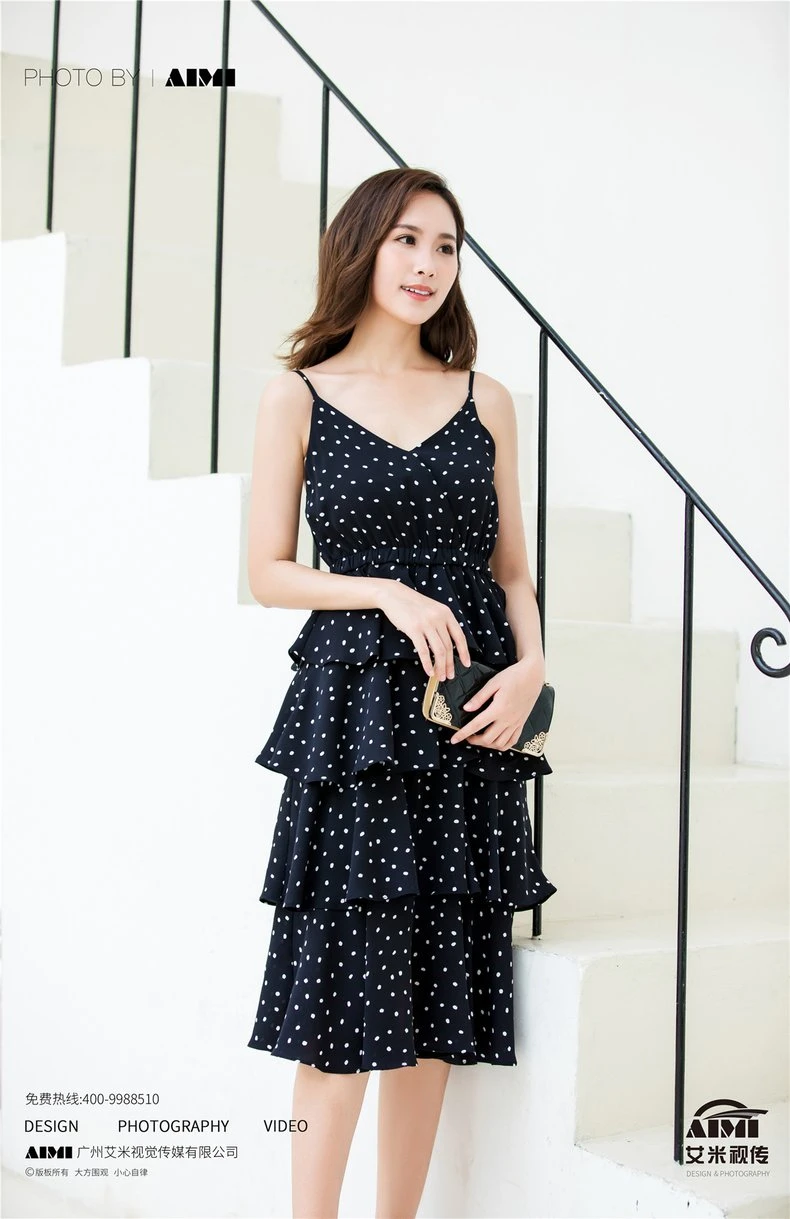


AIMI Visual Media photographed a three-frame series of a black polka-dot spaghetti-strap tiered midi dress on one model, staged on a minimalist white staircase with a black metal railing in bright interior light. The 3 delivered images carry a full commercial license.
▶ View full project details, specifications & FAQ
The client was a womenswear seller listing a black polka-dot midi dress with spaghetti straps, a V-neck, and a tiered ruffle skirt. A playful print needs architecture, not more playfulness, so we staged the series on our minimalist white staircase with its black metal railing, plus one frame against a plain plaster wall, in bright soft interior light. Three frames cover the dress on the stairs, seated, and standing, delivered with a full commercial license.
| Project Overview | |
|---|---|
| Client | Womenswear seller listing a printed tiered midi dress |
| Product | Black polka-dot spaghetti-strap V-neck tiered ruffle midi dress |
| Shots Delivered | 3 interior images (staircase standing, seated, plaster-wall standing) |
| Location | White staircase with black railing, AIMI Guangzhou studio |
| Lead Photographer | Garbo, Senior Photographer |
| Lighting | Bright soft interior light, large frontal source |
| License | Full commercial: store, advertising, marketplace |
Photography Challenges
1. A dot print moires under the wrong lens Fine polka dots at a distance are a classic moire trigger: the print's regular grid interferes with the sensor's pixel grid and the dress shimmers with false patterns. We shot the full-length frames at f/4 on an 85mm and checked each capture at 100 percent zoom, adjusting camera distance a half step until the dots resolved as clean circles. Print moire is a capture problem, not a retouch problem, so it gets solved on the staircase, not in Photoshop.
2. Black dress, black railing, white stairs The set's only dark element is the railing, and the dress's black dots sit one tone away from it, so a careless composition welds the dress to the handrail. We placed the model one step off the rail line so her silhouette reads against the white steps, and kept the railing as a diagonal that leads to her rather than through her. The set's geometry frames the dress instead of fighting it.
3. Tiers need air between them The ruffle tiers are the dress's second feature after the print, and a model standing square and still stacks the flounces into one black mass. We used the staircase itself as the posing tool: one foot on the higher step opens the hip line, and a small turn lets each tier overlap the next with a sliver of light between. The frames show three distinct flounces, which is exactly what a buyer counts.
Our Approach
Lighting
Position: one large soft source frontal and slightly high, white bounce from the staircase itself acting as natural fill. Settings: exposure metered for the dress fabric, background allowed to sit bright. Why: a black-on-white print holds both ends of the histogram, and soft frontal light is the only way to keep the dots black and the ground white in one exposure.
Camera and exposure
Canon EOS R5 on tripod, RF 85mm f/1.4L at f/4 for all three frames, ISO 100, 1/160s. Why: one locked lens at one aperture keeps the print's scale consistent across the series, which is what makes three frames read as one product story.
Set and series
White staircase for two frames, standing and seated, plus one plaster-wall frame as the clean catalog shot. Why: two set slices in one corner of the studio give the listing its lifestyle and catalog frames in under an hour of model time.
"A print dress on a plain set is a negotiation between pattern and architecture: give the print too much visual competition and it turns to noise, give it clean geometry and it sings. The staircase does the framing, the dress does the talking, and that division of labor is how our photography team stages every print-led brief." — Garbo, Senior Photographer
| Technical Specifications | |
|---|---|
| Camera | Canon EOS R5 (45MP full-frame), tripod |
| Lenses | RF 85mm f/1.4L (all three frames, locked) |
| Exposure | f/4, ISO 100, 1/160s |
| Lighting | Large soft frontal source, staircase bounce fill |
| Set | White staircase with black metal railing, plain plaster wall |
| Series | 3 frames: staircase standing, seated, plaster-wall standing |
Frequently Asked Questions
What does a three-frame dress series cost?
On-model studio photography starts at $35 per image under the Growth tier, so a 3-image series like this one starts around $105, with model fees quoted separately. All rates are starting prices; our 2026 pricing guide breaks down the tiers.
How do you stop a dot print from shimmering on camera?
That shimmer is moire, the print's grid fighting the sensor's pixel grid. We control it at capture: f/4 on an 85mm, then checking every frame at full zoom and shifting camera distance until the dots resolve as clean circles. It cannot be fully fixed in retouch, so we solve it on set.
How do you show a tiered skirt's construction?
Pose and overlap. One foot on a higher stair opens the hip line, and a small turn of the body lets each ruffle tier overlap the next with a sliver of light between. In these frames you can count three distinct flounces, which is the detail tier buyers look for.
Can a small set still give catalog and lifestyle frames?
Yes. This series used two slices of one corner, the staircase for the lifestyle frames and a plain plaster wall for the clean catalog frame, all in under an hour of model time. Small sets work when the geometry is planned before the model arrives.
How long does a three-frame series take to deliver?
These 3 images were delivered in 2 business days: a half-day shoot, same-day culling, one day of retouching. Compact series on one set are the fastest model work we book.
Are these frames cleared for marketplace use?
Yes. The full commercial license covers store, marketplace, and advertising use. The standing frames meet Amazon's apparel main-image requirements, and we deliver high-resolution masters plus web-ready crops for each listing slot.
A print dress that deserves clean geometry?
Dress series photographed on our Guangzhou studio sets, with model, styling, and full commercial license included from $35 per image.
Get a Free Custom QuoteView More Womenswear CasesRelated services: Amazon FBA Photography · Near-Factory Photography
Related cases: butterfly chiffon dress studio photography · lace-sleeve party dress photography
 Photography Insights
●How to Choose an Amazon Product Photography Service: A 12-Point Checklist for Sellers, Brand Owners, and Ecommerce Teams
- A 12-point checklist for picking an Amazon product photography service: portfolio depth, pricing transparency, licensing, and turnaround.
●Amazon Product Photography Cost Guide 2026: Complete Price Breakdown & ROI Calculator
- Amazon product photography costs broken down line by line for 2026, with an ROI framework for deciding how many images a SKU actually needs.
●The Complete Guide to Amazon Product Photography 2026: Authoritative Solutions from Compliance to High Conversion
- The complete Amazon image playbook for 2026: compliance specs, slot strategy, A+ Content, and conversion-tested image sequencing.
●Product Photography Pricing in China - 2026 Complete Guide
- Product photography pricing in China for 2026: what drives rates up or down, package tiers, and how to compare quotes on equal terms.
●Amazon Product Photography Requirements, Tips and How to Get It Done in China
- Amazon product photography requirements explained: image specs, main vs lifestyle slots, zoom minimums, and the listing mistakes to avoid.