

Desert Editorial Handbag Campaign Photography
- Published:
- 2018-09-03 16:15:12
- Lead Photographer:
- Garbo (Director of Photography)
- Source:
- AIMI Visual Media
- Last Updated:
- 2026-09-09 09:15:11
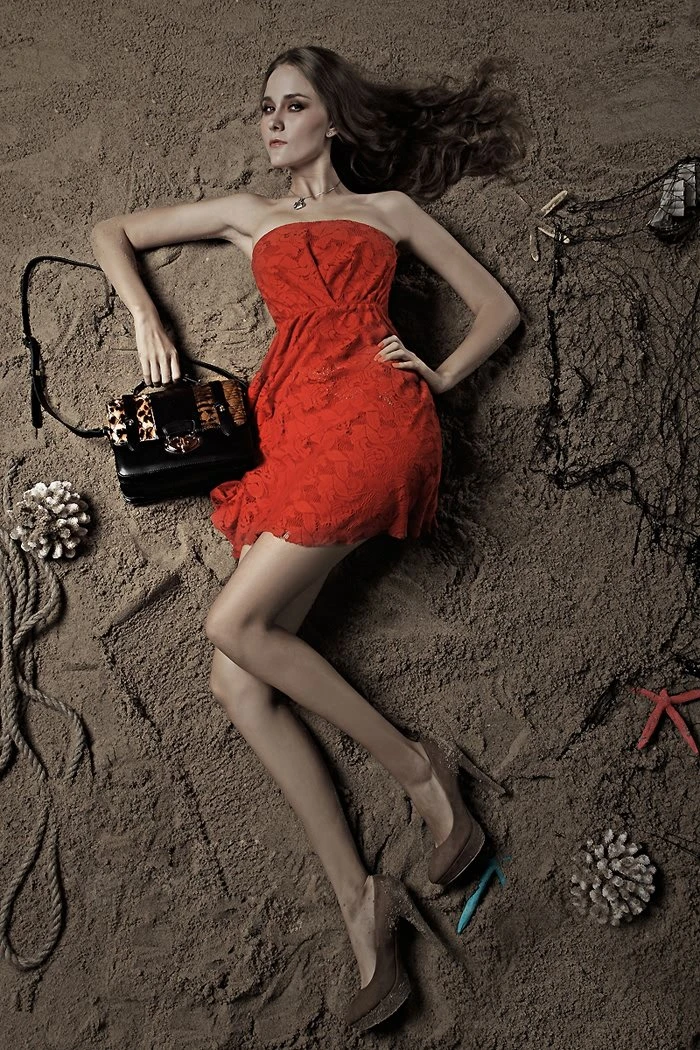
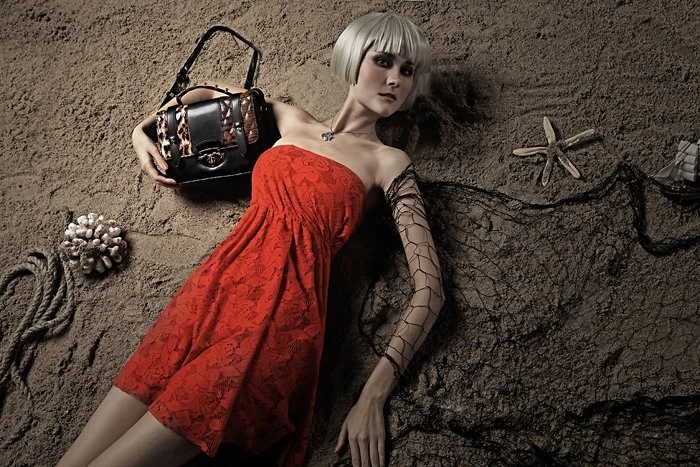
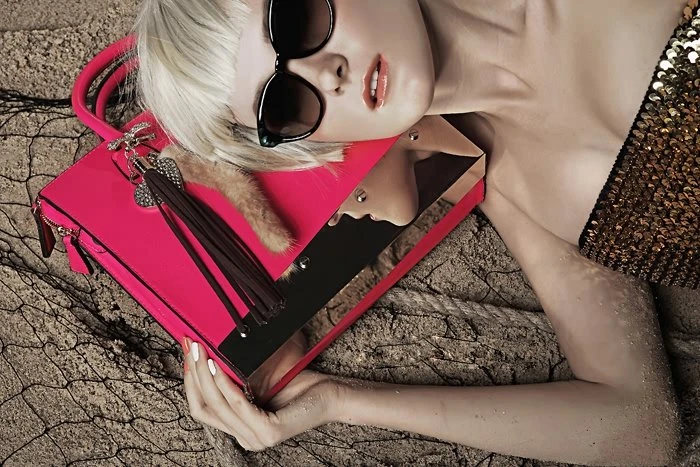
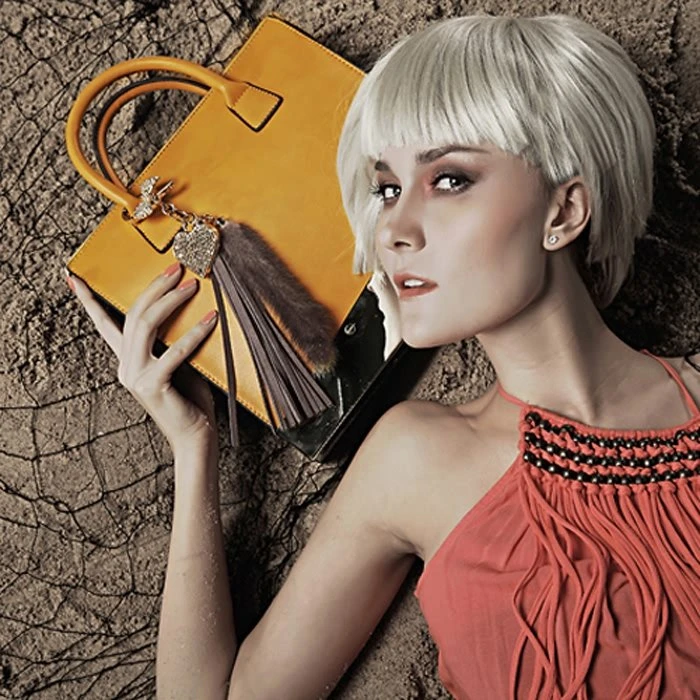
AIMI Visual Media photographed a desert editorial campaign for a fashion label: 4 on-model frames across a built sand set and a cracked-earth flat, with two models and a color-pop grade, delivered in 3 business days at the Guangzhou studio with a full commercial license.
▶ View full project details, specifications & FAQ
The client is a fashion label whose capsule pairs structured satchels with evening lace, and the brief demanded images with editorial gravity, not catalog politeness. AIMI Visual Media built two terrains inside its Guangzhou studio: a castaway sand set dressed with rope, net, and starfish, and a cracked-earth flat for the color-led frames, then shot 4 on-model images across both, with the red lace dress color-popped against a desaturated world. Two models carry the campaign, one dark-haired, one platinum, so the label can speak to two audiences without splitting the story.
| Project Overview | |
|---|---|
| Client | Fashion label, capsule handbag and evening line |
| Product | Structured satchels: black patent leopard-panel, hot pink, mustard |
| Shots Delivered | 4 on-model editorial images |
| Lead Photographer | Garbo (Director of Photography) |
| Shoot Location | AIMI Visual Media studio, Guangzhou |
| Turnaround | 3 business days |
| Usage License | Full commercial license |
Photography Challenges
1. A beach with no weather budget Real sand locations mean tides, wind, permits, and a call sheet held hostage by the forecast. The beach was built on the studio floor instead: packed sand dressed with rope, knotted net, starfish, and a miniature anchor, shot from an overhead rig. Every grain stays where the layout map puts it, and the set stands for a week so new colorways join without a second build.
2. Overhead light on a textured floor Top-down frames on sand punish small light sources: every pebble and prop throws a hard shadow and the surface turns to gravel. The largest softbox in the studio went directly overhead with a slight offset to the upper left, so shadows stay soft and short, the lace reads as texture rather than noise, and the model and bag sit on the sand instead of sinking into it.
3. Patent leather with a mind of its own Black patent has no highlight color of its own; it only mirrors what it faces, and on a dark set that means grey smog. A flagged white panel was positioned where the flap could see it, so the gloss reads as clean streaks of light. The leopard-print panels beside the patent needed the opposite, a flagged zone to keep their spots from flaring, and both disciplines had to coexist in one frame.
4. One red dress in a sepia world The campaign's signature is a color-pop: the crimson lace burns while everything around it mutes to sand and stone. That only works when the set is designed for it, so wardrobe, props, and terrain were all chosen desaturated, and the grade pushed the world toward sepia while the dress hue was protected. A color-pop attempted on a random set looks like a mistake; here it is the architecture.
Our Approach
The castaway overhead rig
Position: camera directly above the sand bed, model supine with the satchel cradled at her shoulder, props arranged to the layout map. Settings: 35mm at f/5.6, ISO 100, overhead softbox with a slight upper-left offset. Why: the overhead angle turns the terrain into the backdrop and the products into islands, which is the entire castaway concept, and it only reads when the light is big enough to keep the floor soft.
Cracked earth for the color frames
Position: the hot pink and mustard satchels on a cracked-earth flat, the platinum model reclining beside them in coral and bronze. Settings: 50mm at f/4, warm key from the front, grade anchored to the same master as the beach frames. Why a second terrain: the pink and mustard bags would have died on taupe sand; the darker, fissured ground gives their colors something to fight against and win.
Two models, one master
Position: the same red dress, the same patent satchel, the same prop map for both beach frames; wardrobe switches to coral and bronze only for the earth set. Settings: identical camera position and light recipe per set, all 4 frames graded to one master. Why: casting two models doubles the campaign's reach without doubling its cost, but only if the world repeats exactly. The faces change; nothing else is allowed to.
"Editorial terrain is a budget trick with an art degree: build the desert indoors, and the weather reports to you. — Garbo" — Garbo, Director of Photography
| Technical Specifications | |
|---|---|
| Camera | Canon EOS R5 (45MP full-frame) |
| Lens | RF 35mm f/1.8 and RF 50mm f/1.8, f/4-f/5.6 |
| Exposure | ISO 100, overhead rig meter locked per set |
| Lighting | Large overhead softbox, flagged white panel for patent reflections, warm key on earth set |
| Set | Built sand bed with rope, net and starfish; cracked-earth flat; selective color-pop grade |
Frequently Asked Questions
What does a 4-frame built-set editorial campaign cost?
On-model frames like these start at $35 per image, so this 4-frame series starts around $140, with model casting quoted separately and set construction priced by scope. The sand bed and cracked-earth flats are built from studio stock, which keeps the build modest. All rates are starting prices; final quotes follow casting, set scope, and frame count.
How long does an editorial set campaign take?
This series was delivered in 3 business days: set construction and the color-pop grade test on day one, one shoot day covering both models across both sets, and finishing on day three. The sets stay standing for a week, so additional colorways join the campaign without a second build.
Is that a real beach and a real desert?
Neither. The beach is a sand bed built on the studio floor with rope, net, starfish, and shell props, and the desert is a cracked-earth flat, both shot under controlled strobes. Building terrain indoors is the whole point: the weather reports to the call sheet, not the other way around.
The dress pops red while everything else mutes. How is that done?
It is a selective grade, decided before the shoot. Wardrobe, props, and set were chosen in desaturated tones, the red lace was the only saturated element in frame, and post work pushed the world toward sepia while protecting the dress hue. A color-pop only works when the set is designed for it; it cannot be faked onto a random photo.
How do you light an overhead sand set?
From directly above with the largest source in the studio. A big overhead softbox keeps shadows soft and short so the model, bag, and props read as shapes on the sand rather than under it, and a slight offset to the upper left gives the lace and the patent leather just enough direction to model their textures.
Black patent on dark sand. How does the bag keep its gloss?
By feeding the patent a bright shape to reflect. Patent leather has no color of its own in highlights, only reflections, so a flagged white panel was positioned where the bag's flap could see it. The gloss reads as clean streaks of light instead of grey smog, and the leopard-print panels keep their spots.
Two models across one campaign. How do you keep continuity?
By repeating everything except the face. The same red dress, same bag, same prop map, same overhead rig for the beach pair, and the same grade master for all four frames. The models change; the world does not, so the campaign reads as one story told twice rather than two unrelated shoots.
Your campaign deserves terrain, not a tablecloth.
Built sets, color-pop grading, and two-model continuity from our Guangzhou studio, from $35 per on-model image with a full commercial license.
Get a Free Custom QuoteView More Bags & Accessories CasesRelated services: Amazon FBA Photography · Near-Factory Photography
Related cases: golden hour tote lookbook outdoor photography · luxury leather winter campaign photography · men's leather backpack forest editorial photography
 Photography Insights
●How to Choose an Amazon Product Photography Service: A 12-Point Checklist for Sellers, Brand Owners, and Ecommerce Teams
- A 12-point checklist for picking an Amazon product photography service: portfolio depth, pricing transparency, licensing, and turnaround.
●Amazon Product Photography Cost Guide 2026: Complete Price Breakdown & ROI Calculator
- Amazon product photography costs broken down line by line for 2026, with an ROI framework for deciding how many images a SKU actually needs.
●The Complete Guide to Amazon Product Photography 2026: Authoritative Solutions from Compliance to High Conversion
- The complete Amazon image playbook for 2026: compliance specs, slot strategy, A+ Content, and conversion-tested image sequencing.
●Product Photography Pricing in China - 2026 Complete Guide
- Product photography pricing in China for 2026: what drives rates up or down, package tiers, and how to compare quotes on equal terms.
●Amazon Product Photography Requirements, Tips and How to Get It Done in China
- Amazon product photography requirements explained: image specs, main vs lifestyle slots, zoom minimums, and the listing mistakes to avoid.