
Shearling is one of the hardest materials to photograph well. It absorbs light unevenly. It casts almost no hard shadow. Depending on humidity and fibre length, the same boot can read as luxurious or as dusty within a 10% lighting variance. In July 2019, AIMI Visual Media began product photography and advertising video work with UGG Auspecial, and the first thing agreed was how shearling would be lit.

About the brand
UGG originated on the shores of Southern California in 1978 and has since built a global reputation on the comfort and material quality of its shearling-lined boots and casual footwear. The brand has expanded beyond its classic wool and leather boot line into a full seasonal range of footwear, apparel, accessories, and bags, sold worldwide as a popular American fashion label.
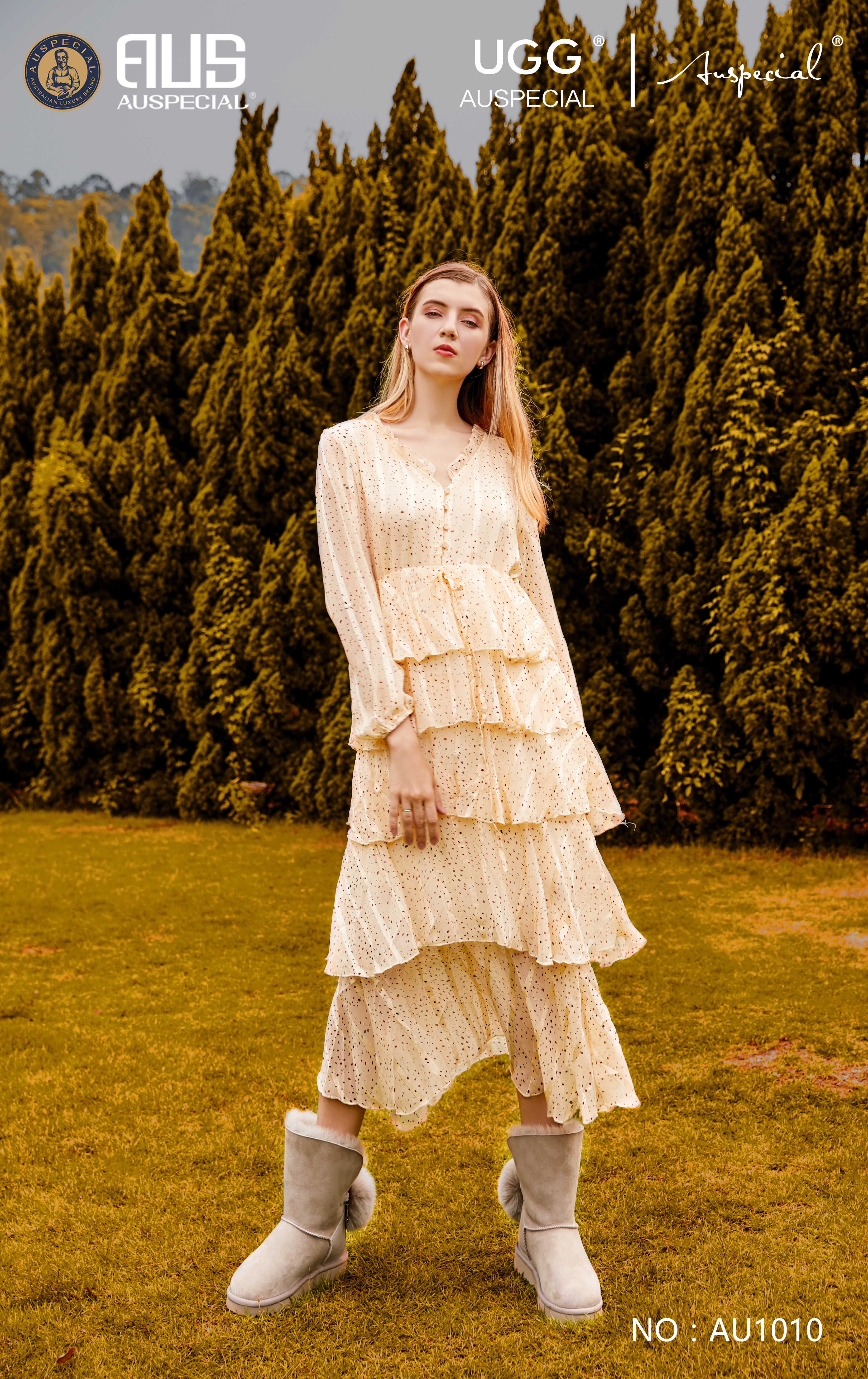
In the Chinese market, UGG Auspecial is the local brand entity AIMI contracted with in 2019, engaging the studio for print advertising photography and advertising video production of footwear product.
Editorial note: “UGG” is a term with complex trademark history across regions — in the United States it is a registered mark held by Deckers Outdoor Corporation, while in Australia “ugg” is a generic term for sheepskin boots used by multiple manufacturers. The entity AIMI worked with trades under the UGG Auspecial brand mark in the Chinese market.
Why shearling footwear is a studio problem
Three material behaviours shape the brief:
1. Anisotropic light absorption
Shearling fibres lie in different directions across the same boot. Under a single-source setup, one panel of the upper reads bright and silvery while the adjacent panel reads dark and dusty — not because the product is flawed, but because the fibres are pointing at the camera differently. The fix is to use two large, orthogonal soft sources so every fibre direction receives a similar energy, and to fine-tune one of them specifically against the collar fold.
2. No hard shadow to anchor the product
Footwear is conventionally anchored to the frame by a cast shadow. Shearling boots produce almost no hard shadow even on a clean floor. Two techniques: a faint practical shadow painted in post for catalogue thumbnails that need the anchor, and a contact-shadow approach using a slightly angled ground plane for editorial hero frames.
3. Humidity and fibre age
Fibre photography is environmentally sensitive. Studio RH above roughly 60% flattens the fleece surface. Brand-new boots look visually different from boots that have been sitting boxed for a week. Shooting schedules account for this — sample conditioning is briefed like any other production variable.
Two frames, two lighting setups
The program’s hero (silhouette boot on clean ground) and material detail (close-up on upper seam and stitching) use different studio configurations. Putting them on separate setups — rather than compromising one lighting design across both — is faster over a full campaign than trying to shoot everything on one rig.
- Hero frame: two orthogonal soft sources, seamless paper ground, subject centred with 40% negative space top and bottom.
- Detail frame: single hard-raking light from camera-left at ~15 degrees to bring out fibre direction and stitch relief, shot at macro distance with narrow depth of field.
About AIMI Visual Media
AIMI Visual Media is a commercial photography studio in Guangzhou, working across product photography, advertising video production, and visual design and direction. Footwear category experience spans athletic, fashion, heritage, and performance sub-categories.
Adjacent footwear and fashion work: Adidas (China) sports footwear and Dior (China) luxury fashion.
Q&A — material-heavy footwear shoots
Can AIMI shoot shearling, leather, and suede in the same production?
Yes, but each material gets its own lighting card in the shot plan. A single lighting rig cannot flatter all three — shearling needs diffuse, leather tolerates specular, suede sits between. Planning to reconfigure between materials is cheaper than reshooting a compromise.
Do you use real feet / models for footwear photography?
For product hero and catalogue work, no — boots are shot on shoe trees or internal forms. For lifestyle and editorial frames, yes. The two outputs are not interchangeable and are usually scheduled as separate half-days.
How does AIMI handle seasonal footwear for e-commerce refresh cycles?
A reference file is kept per style (lighting diagram, lens and distance, retouch LUT) so that refreshed colourways or next-season SKUs can be shot into the same visual grammar without a re-brief.
Where does AIMI shoot footwear — studio or location?
Product photography: studio. Lifestyle and campaign frames: often a hybrid, with the hero subject shot clean and the environment shot separately, then composited under matched light direction.
How do we start?
Email maggie@airmie.com with the styles you want shot, deadline, and any existing reference. AIMI will respond with a shot-per-style plan and quote.
Related case studies
- Adidas (China) — sports footwear photography
- Dior (China) — luxury fashion
- YONEX (China) — precision sports equipment
- All AIMI case studies
Footwear — especially material-heavy styles — on the shot list?
AIMI has a working process for shearling, leather, suede, and mixed-material footwear. Each material gets its own lighting plan rather than sharing a rig, which is cheaper than reshooting a compromise. Send the style list and seasonal window.
Plan a footwear shoot maggie@airmie.com
 Related Articles