

Premium Salt Gift Set Collection Product Photography
- Published:
- 2025-07-27
- Lead Photographer:
- June (Product Photography Team Lead)
- Source:
- AIMI Visual Media Co., Ltd.
- Last Updated:
- 2026-09-14 21:05:18
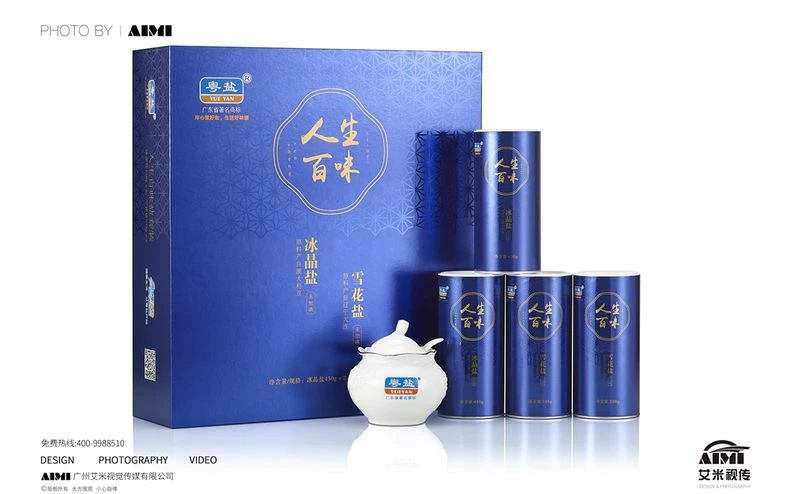
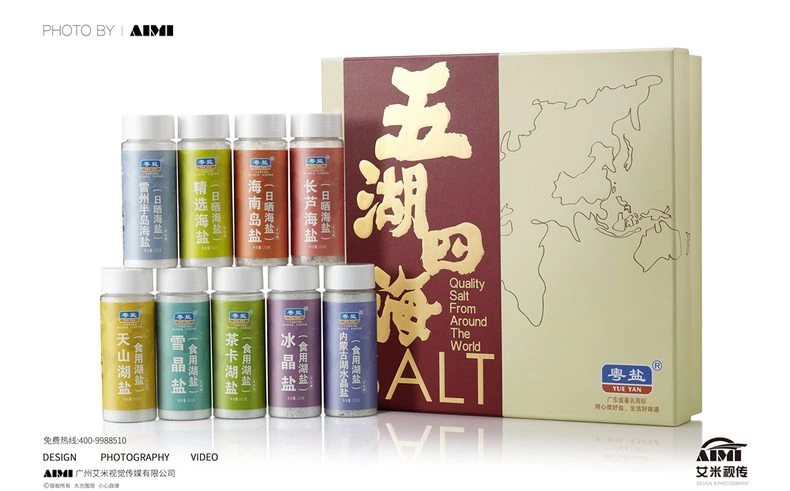
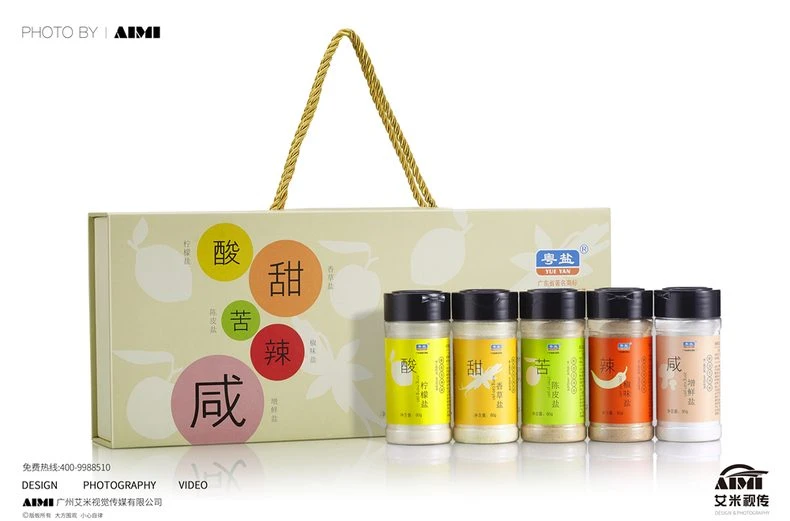
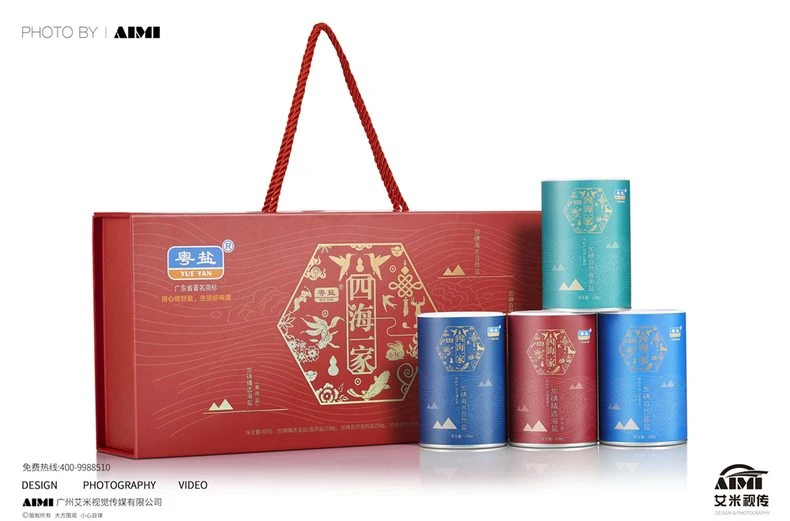
Four premium salt gift set series photographed on pure white background at our Guangzhou studio — a 9-bottle world salt collection, a blue canister set with ceramic jar, a five-flavor shaker line, and a red festive canister gift box. 4 series, 20+ SKUs, delivered in 5 business days for e-commerce and marketplace listings.
▶ View full project details, specifications & FAQ
A Chinese condiment brand commissioned white background product photography of its premium salt gift set collection at our Guangzhou studio. The line includes four distinct packaging series designed for corporate gifting and retail e-commerce: a blue canister set with a ceramic serving jar, a 9-bottle world salt collection in a world-map gift box, a five-flavor seasoned salt shaker line, and a red festive canister gift box with twisted rope handle. Each series uses different dominant colors, materials, and container formats, but all share gold foil branding elements that required controlled specular reflection management. We delivered 4 retouched images, one per series, formatted for Amazon, Shopify, and Tmall listing main image slots. Every file includes a full commercial license for unrestricted use across the brand's sales channels and promotional materials. AIMI Visual Media, Guangzhou, China, handled all photography, color calibration, and post-production in-house.
| Project Overview | |
|---|---|
| Client | Chinese condiment brand (premium salt gift set collection) |
| Product | 4 salt gift set series: blue canister set, 9-bottle world collection, 5-flavor shaker line, red festive canister box |
| Shots Delivered | 4 retouched white background images (1 per series) |
| Lead Photographer | June — Product Photography Team Lead |
| Shoot Location | AIMI Visual Media studio, Guangzhou, China |
| Turnaround | 5 business days (2 days photography, 3 days retouching) |
| Usage License | Full commercial license, no usage restrictions |
Photography Challenges
1. Gold Foil Stamping Reflection Control. Every series in the collection uses gold foil stamping for the brand logo, calligraphy, and decorative emblems. Foil stamping is a mirror-like metal surface applied to cardboard, and it catches any light source pointed in its direction as a bright specular hotspot. A standard softbox aimed at the product from 45 degrees creates a large white rectangle on the foil, blowing out the calligraphy characters underneath. When the brand name becomes a white glare patch, the packaging photograph fails its primary job: showing buyers what the product looks like on a shelf. We solved this with strip softboxes (30cm wide) positioned at 90 degrees to the camera axis, skimming light across the foil surface at a shallow angle instead of hitting it head-on. Black flags placed between the softbox and the product block any stray reflection from reaching the foil at angles that would create hotspots. A circular polarizing filter on the lens suppresses the remaining specular scatter, bringing foil luminosity down to a range where the calligraphy underneath stays readable.
2. Multi-Color Packaging Consistency. The four gift box series use different dominant colors: deep royal blue, bright Chinese red, pale cream, and warm beige. Each color absorbs and reflects light at different rates — blue absorbs warm wavelengths and reflects cool, red does the opposite, and cream/beige sit in the middle. Auto white balance reads each box's dominant color as a color cast and compensates, which means the blue box gets warmed up, the red box gets cooled down, and suddenly the four series look like they come from four different brands. Buyers browsing a collection page expect visual cohesion. We locked white balance to a fixed 5500K (matching strobe color temperature) and shot an X-Rite ColorChecker Passport reference card under set lighting for each series. In post-production, the ColorChecker readings from each series were matched to a single shared baseline, so all four boxes render with consistent color temperature and saturation when placed side by side on a product page.
3. Small Text Legibility on Curved Surfaces. Salt variety names, QR codes, and trademark registration text on the packaging range from 4 to 6 points in print size. The gift boxes are rectangular, but the canisters and bottles have curved surfaces where text wraps around the circumference. At a standard product photography aperture of f/8, the depth of field is roughly 3cm at a 60cm shooting distance — not enough to keep text sharp from the front face to the side edge of a 8cm-diameter canister. Text on the curved edge falls out of focus, making nutritional information and brand details unreadable. We stopped down to f/16, which extends depth of field to approximately 8cm, enough to keep the entire canister face and edge text sharp. At f/16, the aperture lets in 4x less light than f/8, so we increased strobe power from 1/8 to 1/2 output to maintain proper exposure at ISO 100.
4. Transparent Bottle Content Visibility. The 9-bottle world salt collection uses transparent plastic bottles so buyers can see the salt crystals inside — a key selling point that differentiates the product from opaque competitor packaging. Front lighting alone reflects off the bottle's curved plastic surface, creating a bright vertical stripe down the center that hides the salt behind it. Backlighting from directly behind the bottle pushes light through the salt crystals, but it also creates a hotspot on the bottle wall that looks like a manufacturing defect. We placed a 250W strobe behind a translucent acrylic diffuser panel at 60cm behind the bottles, set to 1/4 power. The diffuser spreads the backlight into a soft, even glow that passes through both the plastic wall and the salt crystals, revealing crystal size and color without creating surface hotspots. A white fill card at camera-right bounces front light back onto the colored labels so the brand text stays legible against the backlit glow.
Our Approach
White Sweep Setup and Surface Choice
We built a white sweep using matte white seamless paper rather than glossy acrylic. Glossy surfaces create mirror-like reflections of the product underneath it, which looks elegant for single hero shots but becomes visually noisy when photographing 9 bottles and a large gift box in the same frame — the reflections compete with the product for attention. Matte paper absorbs scattered light and gives a clean, shadow-free gradient from the product base to the background. Products were positioned 40cm from the background sweep to prevent shadow spill onto the white paper, and a separate 250W strobe aimed at the background from behind ensured the sweep rendered as pure white (#FFFFFF) without gray falloff at the edges.
Foil-Safe Lighting Configuration
The core lighting setup used two 30cm strip softboxes mounted on 500W strobes, positioned at 90 degrees to the camera axis (one camera-left, one camera-right) at a 30-degree forward tilt from the product. This cross-lighting approach skims light across the foil surface at a shallow angle rather than hitting it head-on, which prevents the foil from acting like a mirror and reflecting the softbox shape back at the camera. Black foam-core flags (20x30cm) were placed between each softbox and the product at a 45-degree angle, blocking any light that would strike the foil at angles producing specular hotspots. A circular polarizing filter on the lens, rotated to the angle of maximum reflection suppression, removed the remaining scatter. This three-layer approach (strip softbox angle + flag blocking + polarizer) brought foil luminosity into a range where gold calligraphy characters stayed legible at 100% crop.
Color-Calibrated Multi-Series Workflow
All four series were shot in a single session using identical camera position, lens, and lighting. We shot each series at the same 35-degree camera angle and 60cm distance, so buyers can compare the blue, red, cream, and beige boxes side by side without perspective shifts that would make some boxes appear larger or closer than others. Camera white balance was locked to 5500K (matching the strobes' stated color temperature) and never set to auto, which would have read each box's dominant color as a cast and shifted colors between shots. An X-Rite ColorChecker Passport was photographed in set lighting before each series, providing a reference target for post-production color matching. Monitor calibration was verified with an X-Rite i1Display Pro before retouching began.
Post-Production and Retouching
Retouching followed four sequential steps. First, the ColorChecker reference shots from each series were used to create a shared camera profile in Lightroom, which was applied to all 4 images to establish a consistent color baseline. Second, foil areas that still showed minor specular blowout were recovered using the Highlight slider set to -25 and the Whites slider set to -10, pulling blown gold tones back into a range where calligraphy edges are defined. Third, backgrounds were cleaned to pure white (#FFFFFF) using a 5% tolerance magic wand selection on the sweep area, filled with white, and feathered by 2 pixels to prevent hard edges where the product meets the background. Fourth, color saturation was matched across the four series by sampling the blue box's brand blue (HSL: 220, 65, 50) and adjusting the red, cream, and beige boxes so their brand colors sat at equivalent saturation levels on the HSL scale.
"Gift set packaging is a still-life composition problem first, a lighting problem second. You arrange the canisters, the box, and the jar so the eye reads them as one object — then you light the foil without killing the calligraphy underneath." — June, Product Photography Team Lead
| Technical Specifications | |
|---|---|
| Camera | Canon EOS 5D Mark IV (30.4MP full-frame) |
| Lens | Canon EF 100mm f/2.8L Macro IS, at f/16, ISO 100 |
| Lighting | Two 500W strobes with 30cm strip softboxes at 90-degree axis, 30-degree forward tilt; 250W backlight through acrylic diffuser for transparent bottles; 250W background strobe |
| Modifiers | Black foam-core flags (20x30cm) at 45 degrees; circular polarizing filter; white fill card camera-right |
| Surface | Matte white seamless paper sweep |
| Color Management | X-Rite ColorChecker Passport per series, 5500K locked white balance, i1Display Pro monitor calibration |
| Retouching | Shared Lightroom camera profile, foil highlight recovery (-25 highlights, -10 whites), background cleanup to #FFFFFF, HSL saturation matching across 4 series |
| Deliverables | 4 retouched images, 2000x2000px sRGB, JPEG q90 + WebP, full commercial license |
Frequently Asked Questions
How much does salt gift set and food packaging product photography cost?
White background packaging shots like these start at $12 per image under our Essential package. Styled scene or flat-lay compositions start from $35 per image under our Growth package. A 4-image set of gift box packaging costs approximately $48. All rates are starting prices — final quote depends on the number of SKU variants and packaging formats.
How long does a multi-series gift set packaging shoot take?
Our standard turnaround is 5-7 business days from shoot confirmation to final file delivery. This 4-series salt gift set shoot required 2 business days for photography and 3 days for retouching, including color calibration across all four box designs and foil detail recovery.
Can you photograph glossy and foil-stamped packaging without glare?
Yes. We use strip softboxes angled at 30 degrees off-axis from the camera, combined with black flags positioned to block stray reflections from the foil surface. A circular polarizing filter on the lens further suppresses remaining specular hotspots. This setup preserves gold foil calligraphy legibility while keeping the glossy cardboard surface clean.
How do you keep packaging text readable in product photos?
We stop down to f/16 to keep 4-6pt nutritional text and QR codes sharp across the entire carton surface. At f/16, the reduced aperture requires 2x more strobe power than a standard f/8 product shot. We compensate with 500W strobes at 1/2 power rather than raising ISO, keeping image noise at ISO 100 for clean text edges.
Do you deliver Amazon-compliant white background images for food packaging?
Yes. All white background images are delivered at 2000x2000px sRGB with pure white (#FFFFFF) backgrounds, exceeding Amazon's 1000px minimum for the zoom feature. Files are pre-checked against Amazon's 85%+ fill requirement for the main image slot.
Can you photograph transparent bottles showing the product inside?
Yes. For the 9-bottle salt collection, we used a rear-mounted acrylic diffuser panel backlit with a 250W strobe at 1/4 power. This pushes light through the transparent plastic walls to reveal salt crystal texture inside each bottle, without creating hotspots on the bottle surface itself. A front fill card at camera-right lifts shadow detail on the colored labels.
How do you match colors across different colored gift box designs?
We shoot an X-Rite ColorChecker Passport reference card in set lighting for every series, then apply a shared 5500K white balance preset across all four designs. Each box is photographed at the same 35-degree camera angle and distance, so buyers can compare series side by side without perceptual color shifts between blue, red, cream, and beige packaging.
Need professional photography for your gift set and food packaging products?
AIMI Visual Media, Guangzhou, China — white background and styled scene photography for food, beverage, and gift set brands selling on Amazon, Shopify, and Tmall.
Get a Free Custom QuoteView More Home & Living CasesRelated services: Amazon FBA Photography · Near-Factory Photography
Related cases: Pop-it fidget keychain photography · Cartoon storage organizer photography · Laundry pods photography
 Photography Insights
●How to Choose an Amazon Product Photography Service: A 12-Point Checklist for Sellers, Brand Owners, and Ecommerce Teams
- A 12-point checklist for picking an Amazon product photography service: portfolio depth, pricing transparency, licensing, and turnaround.
●Amazon Product Photography Cost Guide 2026: Complete Price Breakdown & ROI Calculator
- Amazon product photography costs broken down line by line for 2026, with an ROI framework for deciding how many images a SKU actually needs.
●The Complete Guide to Amazon Product Photography 2026: Authoritative Solutions from Compliance to High Conversion
- The complete Amazon image playbook for 2026: compliance specs, slot strategy, A+ Content, and conversion-tested image sequencing.
●Product Photography Pricing in China - 2026 Complete Guide
- Product photography pricing in China for 2026: what drives rates up or down, package tiers, and how to compare quotes on equal terms.
●Amazon Product Photography Requirements, Tips and How to Get It Done in China
- Amazon product photography requirements explained: image specs, main vs lifestyle slots, zoom minimums, and the listing mistakes to avoid.