

Wide-Neck Baby Bottle with Handles Product Photography
- Published:
- 2025-08-28
- Lead Photographer:
- June (Product Photography Team Lead)
- Source:
- AIMI Visual Media Co., Ltd.
- Last Updated:
- 2026-09-14 21:05:18
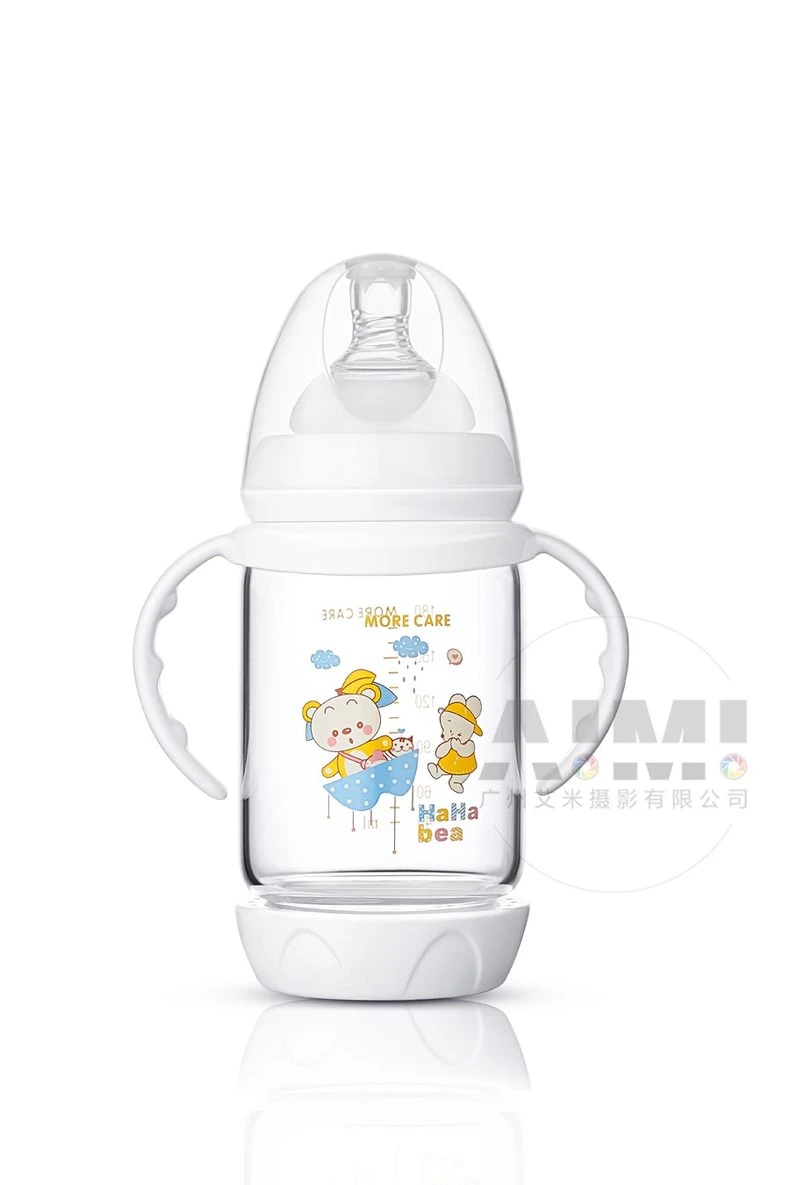
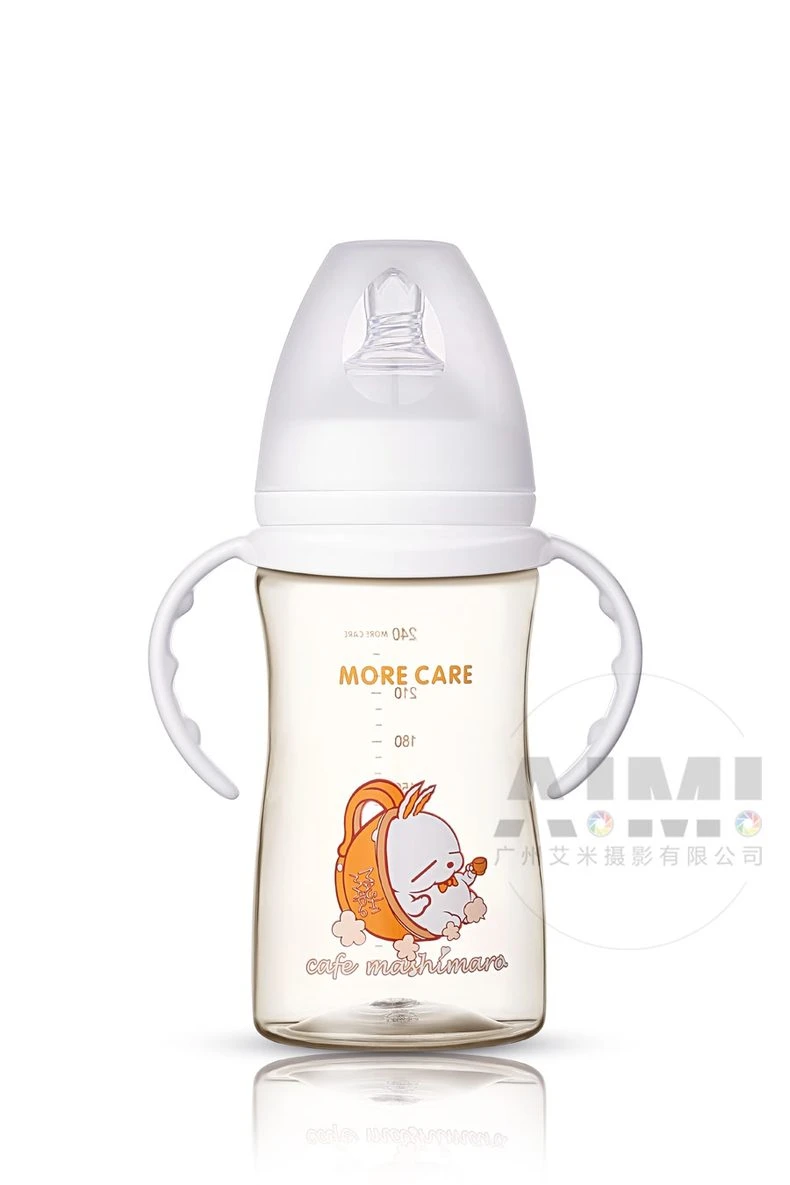
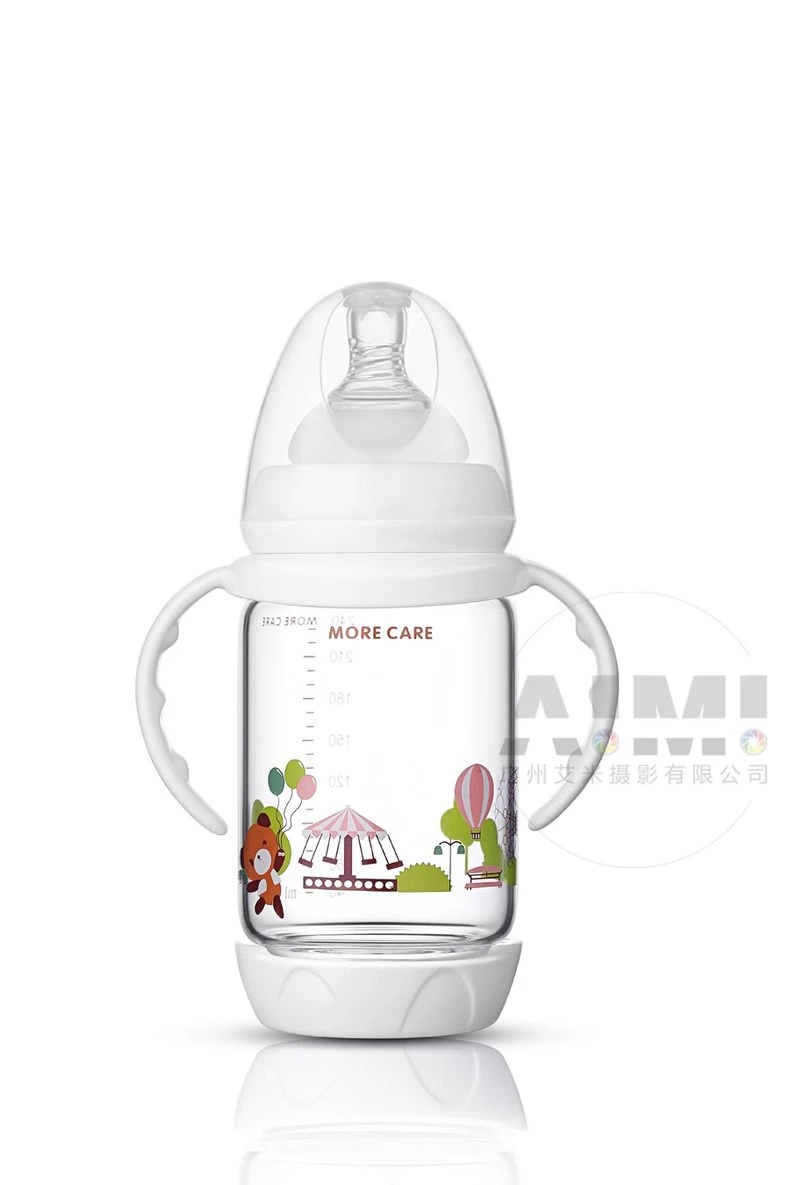
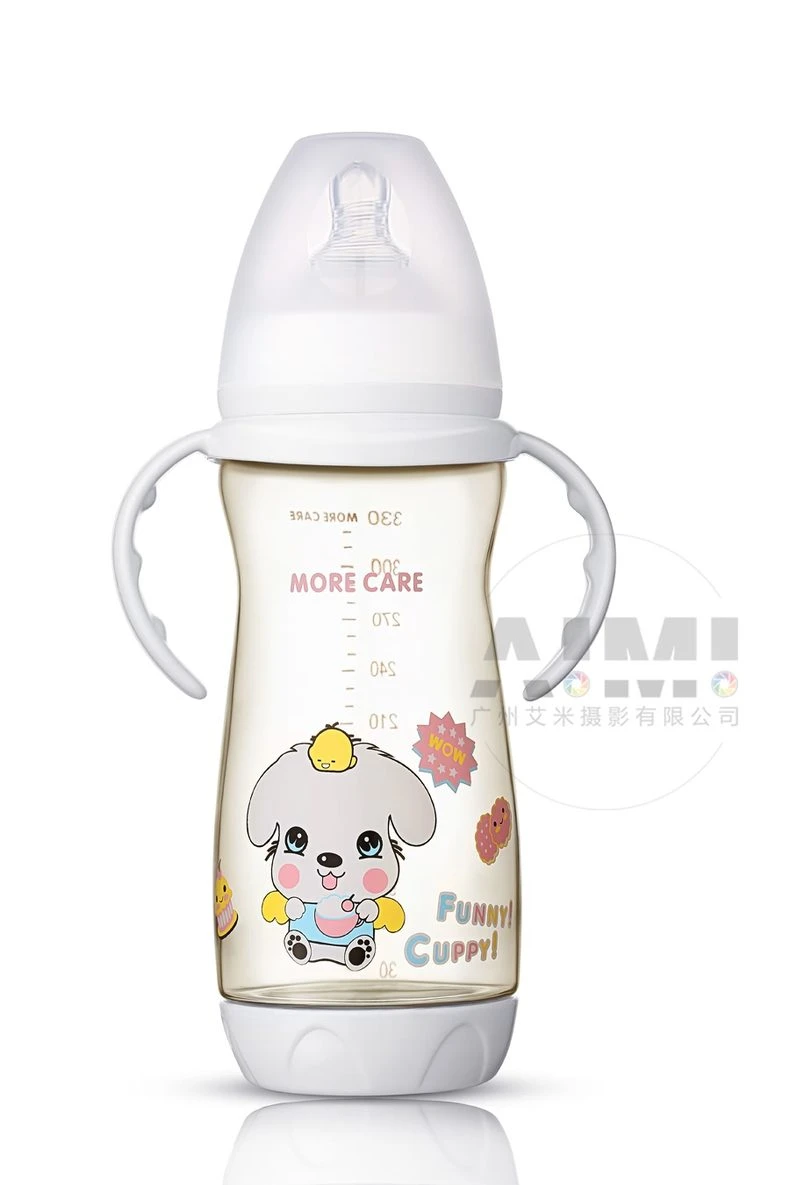
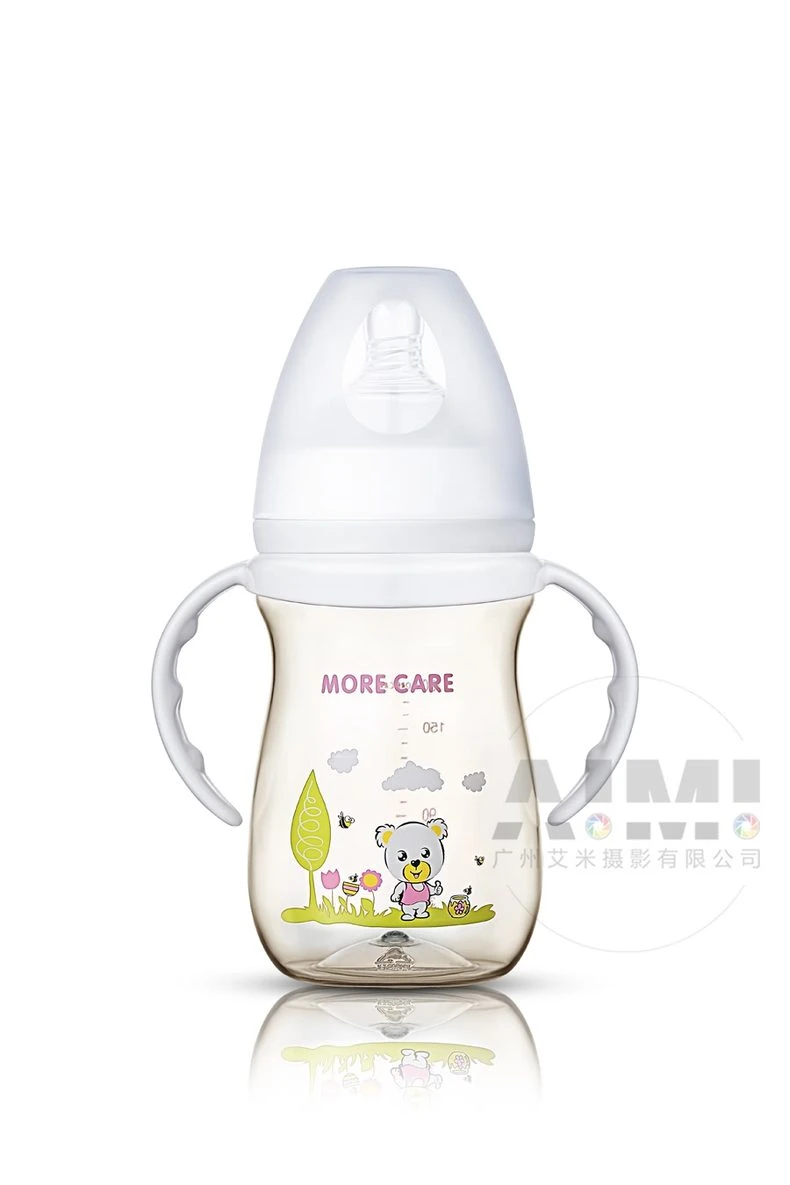
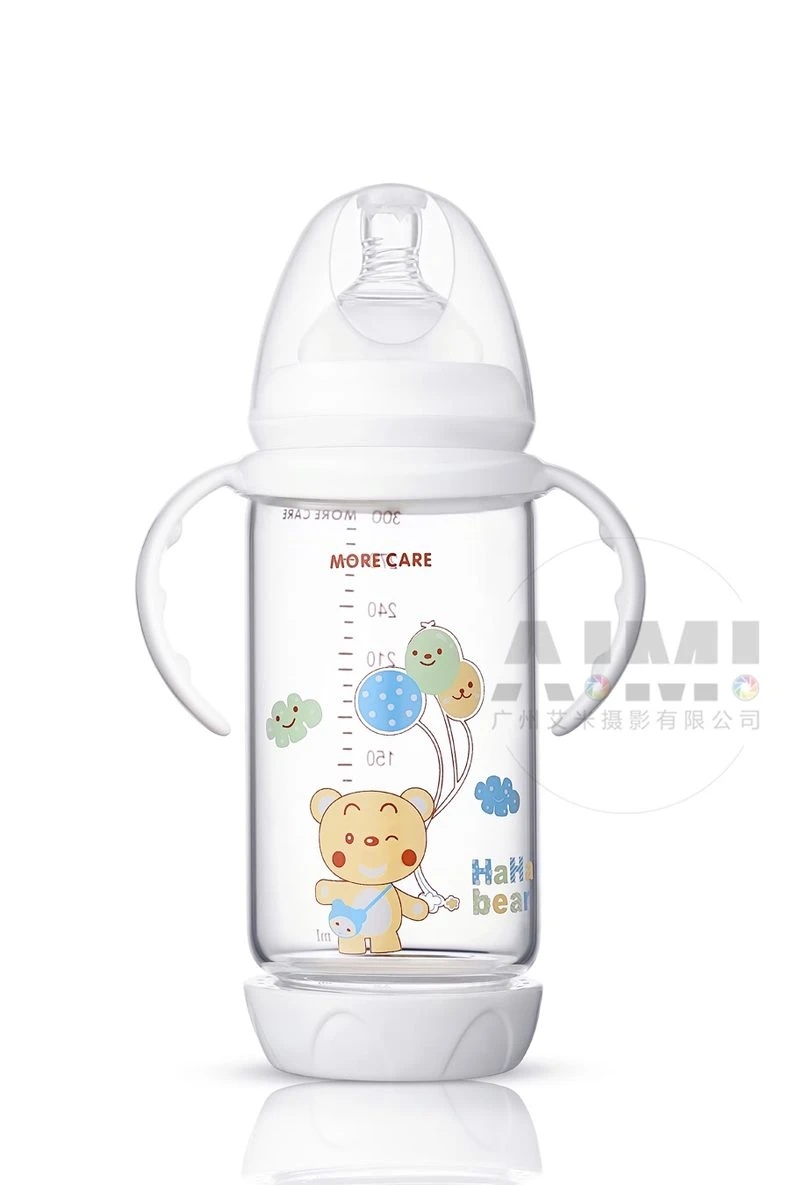
A baby products brand commissioned 6 images of its wide-neck glass baby bottle with dual handles — 4 white background angles showing handle, nipple, and measurement detail, plus 2 styled nursery scene shots. 6 images, 1 SKU, delivered in 5 business days at our Guangzhou studio for Amazon and Shopify listings.
▶ View full project details, specifications & FAQ
A baby products brand approached our team for white background and styled scene product photography of its wide-neck glass baby bottle with dual ergonomic handles, designed for Amazon and Shopify e-commerce listings. The bottle combines a high-borosilicate glass body with PP plastic handles, cap, and base, a food-grade silicone nipple, and a transparent dome cap, decorated with macaron-color printed patterns in yellow, blue, pink, and orange. We delivered 6 retouched images: 4 white background shots at different angles (front, side, three-quarter, detail) and 2 styled nursery scene images with soft curtain light and complementary props. Every file includes a full commercial license for unrestricted use across the brand's sales channels and advertising creative. AIMI Visual Media, Guangzhou, China, handled all photography, prop styling, and post-production in-house.
| Project Overview | |
|---|---|
| Client | Baby products brand (wide-neck glass bottle with handles) |
| Product | High-borosilicate glass baby bottle, PP plastic handles/cap/base, silicone nipple, macaron-color decorative pattern |
| Shots Delivered | 6 retouched images (4 white background + 2 styled scene) |
| Lead Photographer | June — Product Photography Team Lead |
| Shoot Location | AIMI Visual Media studio, Guangzhou, China |
| Turnaround | 5 business days (1 day photography, 3 days retouching) |
| Usage License | Full commercial license, no usage restrictions |
Photography Challenges
1. Glass Body Transparency and Specular Reflection. The bottle body is made of high-borosilicate glass — fully transparent, with a curved cylindrical surface that acts like a lens. Any light source aimed at the bottle from the camera's direction reflects off the curved glass as a bright vertical streak, while everything behind the bottle (light stands, studio walls, the photographer) shows through the glass as dark shapes. A standard softbox aimed from 45 degrees creates a large rectangular highlight on the glass that obscures the decorative pattern and measurement markings underneath. Without controlling these reflections, the bottle looks messy and the buyer cannot see the product through the glare. We solved this with two 30cm strip softboxes positioned at 90 degrees to the camera axis — one camera-left, one camera-right. This cross-lighting setup creates a controlled pair of vertical highlights on the glass surface that define the cylinder's curvature, rather than a single blown-out streak. Black foam-core flags placed behind the bottle on either side create a thin dark edge line along the glass silhouette, separating the transparent body from the white background so the bottle doesn't disappear into the sweep.
2. Dual Handle Symmetry and Camera Angle. The bottle has two handles that protrude outward from the midsection, and each handle casts a shadow that falls asymmetrically depending on the light angle. Handles also block the view of the measurement markings and decorative pattern from certain angles — if the camera is too far left or right, one handle occludes the front face of the bottle. We needed a camera angle that shows both handles in perspective, keeps the front-face pattern and markings readable, and doesn't distort the handle proportions. We positioned the camera at a 15-degree rotation from the bottle's front face, which shows both handles at equal perspective without one appearing larger than the other. At 50mm focal length on a full-frame sensor, this angle avoids the perspective distortion that wider lenses (24-35mm) would introduce, stretching the handle closest to the camera. A 50cm shooting distance gives enough working room for the strip softboxes to clear the handle protrusions without casting handle shadows onto the bottle face.
3. Silicone Nipple Color Accuracy. The silicone nipple has a slight translucent quality with a faint warm tint that shifts under different color temperatures. Buyers judge product quality partly by how clean and medical-grade the nipple looks — a yellowed or discolored nipple reads as aged or low-quality. Auto white balance reads the white PP plastic cap as the dominant tone and adjusts accordingly, but this can push the silicone nipple toward a yellow-green cast under certain strobe conditions. We locked white balance to 5500K (matching the strobes' color temperature) and verified nipple color against a reference product swatch under set lighting before shooting. A 10cm white fill card placed inside the bottle (behind the nipple, visible through the glass) bounces backlight through the silicone, giving it a clean, bright appearance that matches how it looks in natural daylight.
4. Decorative Pattern Legibility on Curved Glass. The macaron-color printed patterns (yellow, blue, pink, orange) are 2-3pt in size, applied to the curved surface of the glass body. At a standard product photography aperture of f/8, the depth of field at 50cm is approximately 3cm — not enough to keep the pattern sharp from the front face to the curved edge of the 6cm-diameter bottle. Patterns on the edge of the curve fall out of focus, looking smudged rather than crisp. We stopped down to f/16, which extends depth of field to approximately 6cm, covering the full diameter of the bottle. At f/16, the aperture lets in 4x less light than f/8, so we increased strobe power from 1/8 to 1/2 output to maintain exposure at ISO 100. This keeps the decorative pattern sharp from front to back without introducing digital noise.
Our Approach
White Sweep and Glass Reflection Control
We built a white sweep using matte white seamless paper for the white background shots (images 1-4). The bottle was positioned on a 5mm clear acrylic riser to lift it off the paper surface, preventing contact shadows that would look like dirt marks on the bottle base. Two 30cm strip softboxes on 500W strobes were positioned at 90 degrees to the camera axis at 45-degree elevation, creating cross-lighting that defines the glass curvature with controlled vertical highlights. Black foam-core flags (15x20cm) placed behind the bottle at 5cm distance create a thin dark edge line along the glass silhouette. A circular polarizing filter on the lens, rotated to maximum suppression, removes the remaining specular scatter from the curved surface.
Camera Angle and Composition for Handle Symmetry
The camera was positioned at a 15-degree rotation from the bottle's front face on a tripod at 50cm distance, using a Canon EF 50mm f/2.5 Compact Macro lens at f/16. This angle shows both handles in equal perspective, keeps the decorative pattern and measurement markings on the front face readable, and avoids the perspective distortion that would make one handle appear larger. For the detail shot (image 4), the camera moved to 20cm distance at the same 50mm focal length, filling the frame with the cap, nipple, and handle junction. The 15-degree rotation was maintained across all 4 white background angles for visual consistency on a product page.
Styled Nursery Scene Setup
For images 5 and 6, we built a styled nursery scene using a white tabletop with sheer white curtains as a soft background diffuser. A brown teddy bear prop was positioned at camera-right, 30cm behind the bottle, to provide a warm color accent that complements the bottle's macaron-color palette without competing for attention. Lighting was adjusted to simulate soft window light: a single 500W strobe with a 120cm octabox was positioned outside the curtain at 2m distance, aimed through the sheer fabric to create a soft, directional glow. The bottle was lit at f/4 (vs f/16 for the white background shots) to create a shallow depth of field that isolates the bottle as the primary subject while keeping the teddy bear and curtains recognizable as soft context.
Post-Production and Retouching
Retouching followed 3 steps. First, glass surface cleanup: the controlled highlight stripes from the strip softboxes were retained as curvature definition, but any stray reflection spots were cloned out using a 30% opacity healing brush to avoid creating uniform-looking plastic surfaces. Second, decorative pattern sharpening: the macaron-color patterns were selectively sharpened using a high-pass filter at 2px radius, applied as a luminosity layer mask to boost edge contrast without affecting the glass surface or background. Third, background cleanup: the white sweep was cleaned to pure white (#FFFFFF) using a 5% tolerance selection with 2px feathering at the bottle silhouette edge. For the styled scene images, color grading was kept warm (5500K baseline, +3 warmth in split toning) to match the nursery mood.
"Glass bottles are the cruelest test of a product photographer's lighting control. The bottle shows you every light you aimed at it — so you either shape the reflections deliberately or you live with a mess." — June, Product Photography Team Lead
| Technical Specifications | |
|---|---|
| Camera | Canon EOS 5D Mark IV (30.4MP full-frame) |
| Lens | Canon EF 50mm f/2.5 Compact Macro, at f/16 (white bg) / f/4 (styled scene), ISO 100 |
| Lighting | Two 500W strobes with 30cm strip softboxes at 90-degree axis; 120cm octabox through curtain for styled scenes; 5500K locked |
| Modifiers | Black foam-core flags (15x20cm) for edge definition; circular polarizing filter; 10cm white fill card inside bottle; 5mm clear acrylic riser |
| Surface | Matte white seamless paper (white bg); white tabletop with sheer curtains (styled scene) |
| Retouching | Glass reflection cleanup (30% opacity healing), high-pass pattern sharpening (2px radius, luminosity mask), background cleanup to #FFFFFF |
| Deliverables | 6 retouched images, 2000x2000px sRGB, JPEG q90 + WebP, full commercial license |
Frequently Asked Questions
How much does baby bottle product photography cost?
White background product shots like these start at $12 per image under our Essential package. Styled nursery scene images start from $35 per image under our Growth package. A 6-image set mixing white background and styled scene shots costs approximately $120. All rates are starting prices; final quote depends on the number of color variants and angle variations.
How long does a baby bottle product shoot take?
Standard turnaround is 5-7 business days from shoot confirmation to final file delivery. This 6-image shoot required 1 day for photography (4 white background angles plus 2 styled scene setups) and 3 days for retouching, including glass reflection cleanup and decorative pattern sharpening.
How do you photograph glass baby bottles without distracting reflections?
We use two strip softboxes at 90 degrees to the camera axis, which creates a controlled vertical highlight on the glass surface rather than a blown-out white streak. Black flags placed behind the bottle on either side define the glass edge with a thin dark line, separating the transparent body from the white background. A circular polarizing filter on the lens suppresses remaining specular scatter from the curved glass surface.
Are your baby bottle images compliant with Amazon baby product category requirements?
Yes. All white background images are delivered at 2000x2000px sRGB with pure white (#FFFFFF) backgrounds, exceeding Amazon's 1000px minimum for the zoom feature. Files are pre-checked against Amazon's 85%+ fill ratio requirement for the main image slot. Styled scene images are delivered as secondary listing images.
How do you keep small decorative patterns and measurement markings sharp on a curved bottle?
We stop down to f/16 to keep the macaron-color printed patterns and measurement graduations sharp across the entire curved glass surface. At f/16, depth of field extends to approximately 6cm at a 50cm shooting distance, enough to cover the full diameter of the bottle. We compensate for the reduced aperture with 500W strobes at 1/2 power, maintaining ISO 100 for clean pattern edges.
Can you photograph baby bottles in styled nursery scenes?
Yes. Images 5 and 6 were shot in a styled nursery setup with sheer white curtains, a brown teddy bear prop, and soft natural-style window light. Props are chosen to complement the bottle's pastel macaron-color palette without competing for visual attention. Depth of field is set to f/4 to isolate the bottle as the primary subject while keeping props recognizable as contextual background.
Need professional photography for your baby bottles and feeding products?
AIMI Visual Media, Guangzhou, China — white background and styled scene photography for baby product brands selling on Amazon, Shopify, and Tmall.
Get a Free Custom QuoteView More Home & Living CasesRelated services: Amazon FBA Photography · Near-Factory Photography
Related cases: Baby feeding bottle & fruit feeder photography · Children formula packaging & baby bottle photography · Ergonomic baby carrier photography
 Photography Insights
●How to Choose an Amazon Product Photography Service: A 12-Point Checklist for Sellers, Brand Owners, and Ecommerce Teams
- A 12-point checklist for picking an Amazon product photography service: portfolio depth, pricing transparency, licensing, and turnaround.
●Amazon Product Photography Cost Guide 2026: Complete Price Breakdown & ROI Calculator
- Amazon product photography costs broken down line by line for 2026, with an ROI framework for deciding how many images a SKU actually needs.
●The Complete Guide to Amazon Product Photography 2026: Authoritative Solutions from Compliance to High Conversion
- The complete Amazon image playbook for 2026: compliance specs, slot strategy, A+ Content, and conversion-tested image sequencing.
●Product Photography Pricing in China - 2026 Complete Guide
- Product photography pricing in China for 2026: what drives rates up or down, package tiers, and how to compare quotes on equal terms.
●Amazon Product Photography Requirements, Tips and How to Get It Done in China
- Amazon product photography requirements explained: image specs, main vs lifestyle slots, zoom minimums, and the listing mistakes to avoid.